Tuesday, August 9, 2022

Subspecies IV: Bloodstorm (Romania / USA, 1998)

Subspecies IV: Bloodstorm — the film is the fourth and for a long time final film of Full Moon's Subspecies franchise, and tangentially related to the one-shot Subspecies spin-off, The Vampire Journals (1997 / trailer). And sitting as it does preceded by so much past — namely: Subspecies (1991 / trailer), Subspecies: Helldance (1993 / trailer) and Subspecies III: Bloodlust (1994 / trailer) — a pertinent question that arises is whether there is any point in watching the film if one is completely unfamiliar with the series and narratives that preceded this once-final franchise installment.* The answer to that, we are pleased to say, is yes: any and all knowledge of prior events that is really required is succinctly and well presented in the first five minutes, after which the movie strides resolutely and entertainingly forward to present its own story. And does so surprisingly well.
* We say "once final" because it would seem that currently, as in 2021/22, over two decades after Bloodstorm, a new installment is in production: Subspecies V: Blood Rise. This time around, the film is going to be a prequel. Thereafter, who knows — how about Subspecies VI: Blood in Space?
Trailer to
Subspecies IV: Bloodstorm:
In many ways, Full Moon films are like the Poverty Row films of yesteryear, only instead of being the second feature, they are direct to video/DVD. Populated with names that are usually far from big or even mildly familiar (unless the name is on the skids), the productions are a varied bag of terrible to fun time-wasters, with a rare, unexpectedly pleasant surprise sometimes amongst them. Logic and proportion are often sloppy or dead, the acting and direction variable. By way of example, you could compare a few of the second-feature Bela Lugosi films we've watched in the past: The Corpse Vanishes (1942), like BL vs the Brooklyn Gorilla (1952), is a pretty "terrible" film, but whereas the latter enjoyable merely as a Guilty Pleasure, the former displays a knowingly campy and surreal humor that reveals the filmmakers knew they were making crap and just had fun with it — to the advantage of the film. In turn, White Zombie (1932), for all its lowly roots and nano-budget, is an artistic achievement. It is a movie that seriously transcends its wrong-side-of-the-tracks roots and can stand proudly as a good movie. (How that ever happened is perhaps a mystery, seeing that all those involved never managed to rise that high again.) Full Moon projects are just as variable: terrible to absolutely great, you seldom know in advance which.
We can't speak for the earlier Subspecies entries, but when it comes to this one, Bloodstorm, the movie is less related to Brooklyn Gorilla than it is (if nevertheless extremely distantly) to White Zombie. The at-times somewhat disjointed story might have its lapses in logic, its cheap necessities, and its deus ex machinas, and the acting might be truly variable, but visually the direction is nothing to sneeze at: it is often a beautiful movie with pleasant (but in full color) references to the visual style of the silent horror classics.
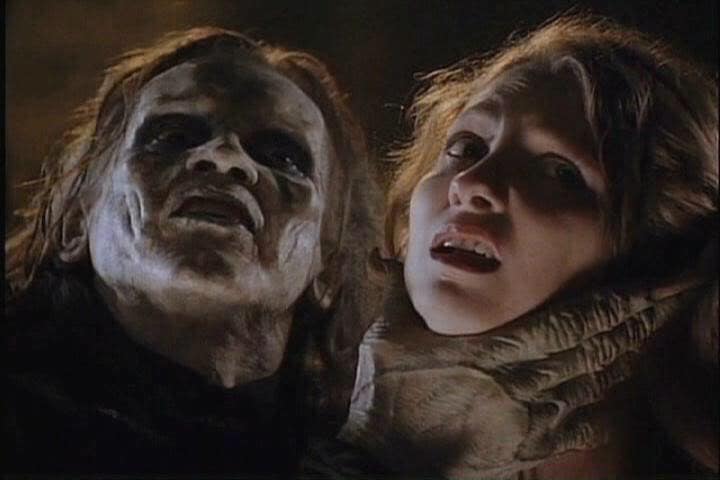
In that sense, director Ted Nicolaou, a low-budget director of prodigious output, reveals a visual talent and creativity sorely lacking in another, perhaps better-known, low-budget director of prodigious output, David DeCoteau. Lighting-wise, their films often look the same, but whereas DeCoteau seems to prefer a moribund camera and visual somnambulance, Nicolaou knows how to move or tilt the camera and keep the film visually appealing. This talent does a lot to give a movie some life, and make the flick a far more enjoyable cinematic experience; thus, though the narratives of the respective journeymen might be of equal feebleness, Nicolaou's movies are invariably better.
Dare we hypothesize that the filmic difference in the two directors' respective roots is apparent in the product of the two? DeCoteau learned the ropes doing no-budget porn, hardly the most visually creative genre (other than for rare exceptions like Thundercrack [1975 / scene / scene / scene] or Hardgore [1974]), while Nicolaue went from graduating from the University of Texas film program to recording sound for Tobe Hooper's original The Texas Chain Saw Massacre (1974) and then to editing idiosyncratic flicks like Tourist Trap (1979) and Butcher, Baker, Nightmare Maker (1983 / fan trailer, with Susan Tyrrell). Going by Bloodstorm, the man has some artistic intentions despite the lowly genres he works in and his definitely non-A employers. If DeCoteau has already long become today's William "One-shot" Beaudine (15 Jan 1970 – 18 Mar 1970), Nicolaue may be, maybe, on his way to becoming today's unsung Edgar Ulmer (17 Sep 1904 – 30 Sep 1972).
The titular "subspecies" of the other Subspecies films — monstrous minions to the undead — are missing from this entry, which is very much a contemporary, gothic-tinged vampire tale. Nosferatu's first cousin Radu Vladislas (Anders Hove), always killed at the end of each Subspecies film only to be resurrected in the next, is back again (thanks to a believably possible stroke of luck) and still obsessed with getting the beautiful Michelle Morgan (Denice Duff) to fully reject her humanity and accept her role as his vampire mate — something she comes very close to doing.
The two are basically the only characters (other than a pathetic and rather unnecessary policeman, Lt. Marin [Ion Haiduc of Last Gasp (1995 / trailer)], whose presence is more to fill running time than to advance the story) to return from the Subspecies franchise: since the actors Kevin Spirtas (of Albino Farm [2009 / trailer], Embrace the Darkness [1999 / some song in a foreign language] and Wes Craven's disgraceful The Hills Have Eyes II [1984]) and Melanie Shatner (of The Alien Within [1995 / trailer], Syngenor [1990 / German trailer] and Juan Piquer Simón's Cthulhu Mansion [1992 / trailer]) were unable to return to play Mel and Rebecca from Subspecies II and III, they are summarily killed off at the start of the Bloodstorm by means of a prudently edited (no faces shown) and auspiciously timed car accident. In a further case of fortuity as only occurs in movies, a passing doctor, Ana Lazar (Ioana Abur of The Crucifixion [2017 / trailer]), arrives on the scene and, thinking that Michelle is still alive, carts her off to the private clinic where she works. There, her former lover and current boss, Dr Niculescu (an over-acting and almost camp Mihai Dinvale of Shapeshifter [1999 / trailer] and Dark Angel: The Ascent [1994 / trailer]) recognizes a vampire when he sees one and is convinced he can cure her. Oh, as is pretty quickly obvious: he, too, is a vampire, though obviously not under the thrall of any master, and is hot to get hold of the legendary Bloodstone, the ancient relic that gives the master vampire Radu his power....
The Romanian locations are always attractive and fitting for the tale. As Dr Niculescu, Mihai Dinvale's acting takes a bit of time to get used to, as he is really the only cast member going for high camp and his style does clash a bit with the more naturalistic or non-style of the rest of the cast. The film plays well with his intentions and hidden agenda, and one is seldom sure of his loyalties, which adds a bit of depth to his overly arch character. Anders Hove is properly repulsive as the deeply evil Radu Vladislas, and while Denice Duff is arguably more an attractive than good actor, she does a half-way decent job in portraying Michelle's emotional indecisiveness and flipping and flopping between giving in to and fighting her rising evilness. It was a cute touch on part of Nicolaou to contrive to get her dressed in what is basically a flowing white nightgown, as it works both as a symbol of what Michelle would like to stay ("good") and as homage to the Gothic films of yore. It also functions as an intensification of the movie's own Gothic atmosphere. The two vampires written in from The Vampire Journals, Ash (Jonathon Morris of Screamtime [1983 / trailer]) and Serena (Floriela Grappini), fit better into the narrative than one might expect, though Serena definitely suffers from some bad 1990s fashion concepts.
So there you have it: Bloodstorm is a surprisingly well-made and watchable low-budget vampire film of unexpected stylistic panache, the last of which helps greatly to smooth over the narrative and thespian weaknesses. We, in any event — and thanks only to this movie — are now definitely not averse to watching the earlier films of the franchise.

Tuesday, August 2, 2022

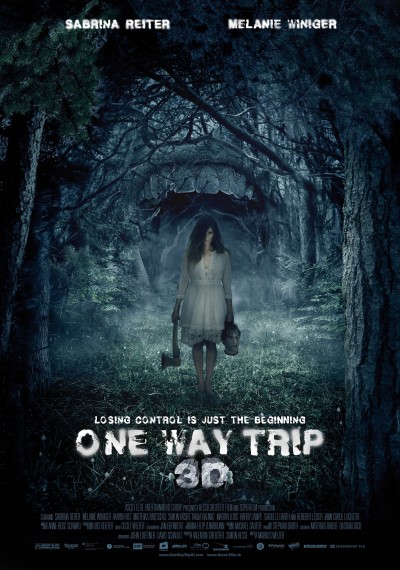
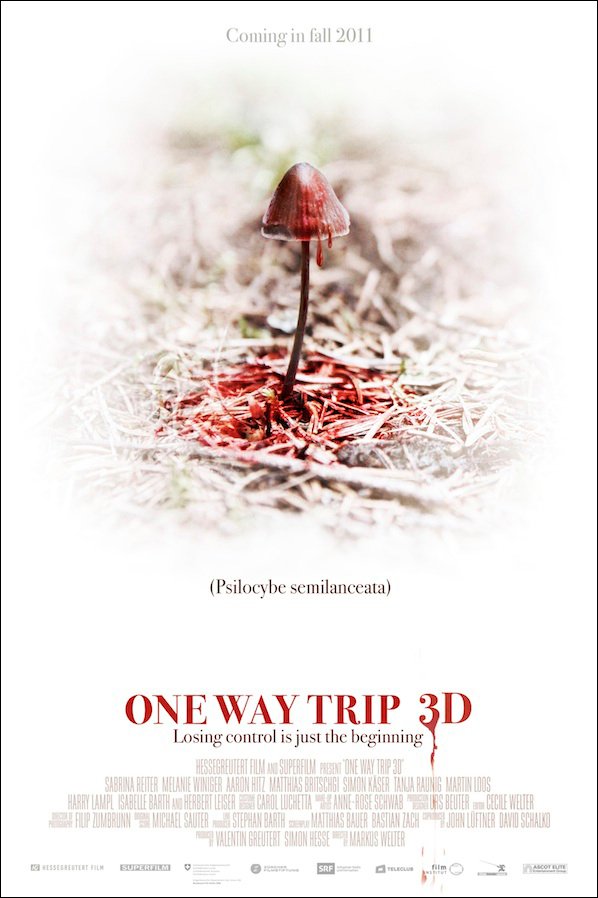
One Way Trip (Switzerland, 2011)

Spoilers. Hmmm, don't think we've ever caught a Swiss horror movie before this one. We wish we could say it was an experience of note, but, nope: One Way Ticket is nothing to write home about. It isn't even decent Swiss Cheese.
Indeed, it left us asking ourselves a rhetorical question: Would someone who has never had sex see themself as capable of directing a sex film? Because it sure seems that more than enough people out there who have obviously never taken this or that drug sure don't have any qualms about making films involving drugs. (Reefer Madness [1936 / full film], anyone?) This movie is a good example: it is more than obvious that none of the three forces behind the narrative (scriptwriters Matthias Bauer and Bastian Zach, and director Markus Welter) have ever taken mushrooms before. Nevertheless, their obvious lack of any knowledge about the subject didn't stop them from making this totally non-imperative, brainless, and by-the-numbers bodycounter, the only saving grace of which is not that it was released in 3-D, but that it has Miss Switzerland 1996, Melanie "Yummy-Yummy" Winiger, playing the hot, facially scarred red-herring Marlene.
 
German-language Trailer to
One Way Trip:
The movie opens in Zurich, where five friends meet to drive off for a weekend outing. In less time that it takes for the viewer to catch all the names of the characters, two things become obvious, one: the five are the typically unrealistic friends of bad horror films, the kind that in real life you wouldn't spend any time with other than to whack across the face while screaming "Die! Die!" — and two: Valerie (Sabrina Reiter) is going to be the Final Girl. And she is. And that is how obvious the generic horror aspects of this movie are. It's where the film tries to be clever, tries to use its anti-mushroom sentiments as the foundation of the big twist, that it falls apart and reveals itself to be a car wreck of a movie: it holds water like a shit-stained, wet piece of toilet paper. And is only marginally more interesting.
You ever see the equally stupid anti-mushroom movie Shrooms (2007)? We did, so you don't have to... but One Way Trip's scriptwriters Matthias Bauer and Bastian Zach obviously saw the movie and liked it, because they basically crib the idea but transplant the action from an Irish forest to a Swiss forest, and instead of special kind of shroom being bad (in Shrooms: the "Death Head" shroom), they make all magic mushrooms bad. (And really magic, too, as everyone basically is suffering the same bad trip. An impossibility, needless to say.)
Oh, yeah: Bauer and Zach also obviously saw some stupid killer-hicks film — Wrong Turn (2003 / trailer), maybe? Deliverance (1972 / trailer)? It doesn't really matter; whatever film it was, it is surely a better one than One Way Trip — and decided to try to combine the two. Well, as Robert Burns was wont to say, "The best laid schemes o' mice an' men, Gang aft a-gley."*
* Speaking of Burns, actually, one good thing about the film is that although it is set in Switzerland and all the characters are supposedly Swiss, they all inexplicably speak dialect-free standard German — even the Swiss hicks. So if you speak German, it's easy enough to follow.
But back to the five friends. Obviously five over-aged young folks are not enough future dead, so contrivances of the most idiotic nature result in Valerie's ex-boyfriend joining the fray, and suddenly two strangers, clingy Lilli (Tanja Raunig) and sleazy Lars (Matthias Britschgi), join the troop. With eight, Bauer & Zach obviously thought they had enough fodder, for it is at this point that the movie tries (and ultimately fails) to go bodycount horror movie.
What happens? Well, the group all hunt, find, and take mushrooms and then while they all trip happily away, Timo (Harry Lampl of Initiation [2009 / scene]) suddenly gets injured, a thunder storm rolls in — seriously?!? — and they suddenly appear totally sober and head off in search of the car. They find a deserted manor house with courtyard buildings instead — and thus the bodies start to fall. Including one person who, before he's killed, is tied up and has his mouth stuffed and face covered with silk stockings (that all other fodder also later see): an impossibility because after the big twist, the viewer can't help but realize that the real killer was never wearing silk stockings.
Okay, the film sucks, so we'll reveal the film's twist: They are all still tripping on shrooms (a drug that usually makes you happy and peaceful) and, under the influence of one major shared bad trip, are actually killing each other.
What bullshit. Like the whole film. When a film about drugs so obviously shrieks that it knows nothing about the drug, it fails to become anything other than a didactic tract. You know the great "educational film" maker Sid Davis (1 April 1916 – 16 Oct 2006)? (If not, see our Short Film of the Month for Sept 2017, Seduction of the Innocent [1961], and Sept 2013, Boys Beware [1961].) One Way Trip film tastes/feels as if Sid had suddenly decided to make one of his "informative" anti-drug movies in the form of a feature-length, German-language horror movie, and the movie is about as intelligent as one of his filmic tirades — unluckily, it is also a lot less funny.
To sing praise where praise is undeserved because the film as a whole sucks so majorly, there are a few nice shots and moments in the movie. A death taken from the opening scene of that great Mario Bava movie Kill, Baby... Kill (1966 / trailer) is nicely staged; Lars is a convincing asshole and the hallucination of his big head is pretty funny; the extended shot following Valerie as she's being lifted out of the pit by a rescue crane is nice; the nonchalantly careless way the fat guy keeps pointing the found shotgun this and that way is unnerving; the 3-D isn't the worst 3-D out there; the mysterious way the entire interior of one room changes between the glances two different characters give into it is properly surprising; the scenery is great (indeed, we think we will make plans to visit the Canton of Jura); and... and... and... Well, that's it.
One of the characters says, more than once, "Wie im Lehrbuch," or "Like in a textbook." And that is what the horror aspects of One Way Trip feel like: taken from a textbook of how to make a dry and unoriginal horror movie, the filmmakers check off the boxes to "required scenes" one by one. (The step/box they overlooked was one says, "Try to be original.) One character even says "We should split up" at one point, and it doesn't come across as an in-film joke.
There is really nothing about One Way Trip that makes it worth watching. It is simply too unoriginal, unintelligent, unfunny, unscary, and uninteresting that the few plus points can in any way save it. It is a film that screams to be hated, and we here at a wasted life hated it. You will, too.
And as a last, very petty criticism: Why the fuck "One Way Trip" and not the grammatically correct "One-way Trip"? (Oh, yeah: because the people who made this flick are lazy idiots.)

Monday, July 25, 2022

Short Film: In One Drag (Germany, 2016)

Here's a quick little film that puts a new spin on "the horrors of smoking". The three-minute stop-motion film is by Alireza Hashempour, made while the Tehran-born, freelance 2-D and stop-motion filmmaker was still a student at Filmakademie Baden-Württemberg in Ludwigsburg. One might read the short as a wish-fulfillment film: who hasn't wished, at some point in their life, that the jackasses that see fit to throw their non-biodegradable cigarette stubs everywhere wouldn't get their due? (And we say that as an occasional smoker.)
In any event, In One Drag is well-made and stylistically assured, funny and horrific, and definitely doesn't overstay its welcome. Enjoy. 

Tuesday, July 19, 2022

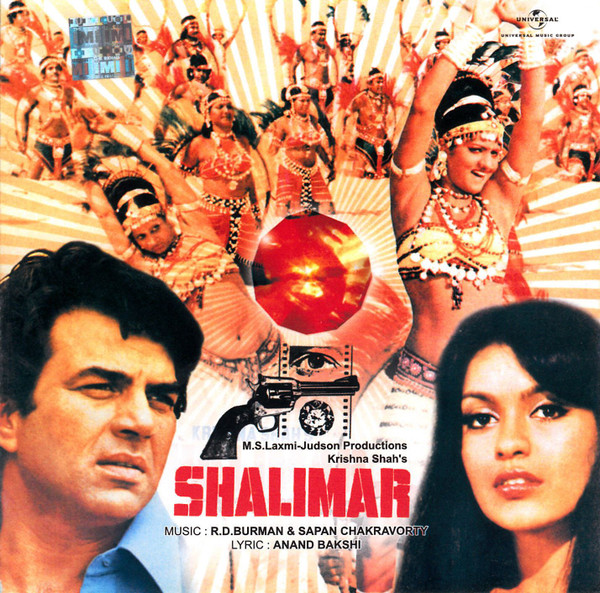
The Deadly Thief (India, 1978)

Well, they sure tricked us on this one: when we picked up this one-dollar double feature DVD at Dollar Tree in Vegas over a decade ago, we thought we were getting some obscure thriller starring a slumming Rex Harrison (5 Mar 1908 – 2 Jun 1990) titled The Deadly Thief. And then, yesterday, after we finally got around to popping the disc into our DVD player, we found we had actually gotten ourselves an obscure Bollywood thriller (?) starring a slumming Rex Harrison titled Shalimar. Or at least a cut of that film, possibly once titled Raiders of the Sacred Stone, which was intended for Western audiences.
Argentinean trailer to
The Deadly Thief:

And as an added pleasure, this unknown, obscure Bollywood thriller stars not only a slumming Rex Harrison, but also features the great John Saxon (5 Aug 1936 – 25 Jul 2020, below not from the film) and an incredibly miscast and wonderfully out-of-place Sylvia Miles ([9 Sept 1924 – 12 Jun 2019] of The Sentinel [1977 / trailer], Tobe Hooper's The Funhouse [1981 / trailer] and Violent Midnight [1963 / full film, with James Farentino]) — all three in their only Bollywood appearances ever. And the wonders of what you learn on the internet: Sylvia Miles replaced the original star signed, Gina "36-22-35" Lollobrigida, who bailed the project shortly after arriving to India.*
* "It is April 1977 in Bombay, and at the muhurat of Shalimar, Bollywood's landmark international flop, Zeenat Aman and Gina Lollobrigida are fighting for supremacy on the lawns of the Turf Club. Their chosen weapons are thigh-high side-slits and plunging necklines. Lollobrigida loses out to a much younger Aman and bails out of the film in disgust, to be replaced by an 'old-looking, shrivelled, passionless and temperamental Sylvia Miles'. [Indian Express]"

"Obscure Bollywood thriller" is naturally a relative phrase. Harold Robbins (who?), for example, is surely an obscure American writer to most people in India — if not, by now and despite his former fame, to most of the world. In its day, Shalimar cum The Deadly Thief cum Raiders of the Sacred Stone may have been a flop in its homeland (likewise not making a ripple in the rest of the world), but studded with names that are well-known in India, the movie was the most expensive Bollywood production to date in 1978, and thus infamous. (Infamous precludes obscurity.)
Supposedly Shalimar cum The Deadly Thief
cum Raiders of the Sacred Stone has since garnered a cult following, while its soundtrack has long since become a popular source of samples. However: the 90-minute English-language version of the movie (the Hindi-language version is around 137 minutes), lacking almost all musical numbers as well as the introduction and a lot of character back-story, leans definitely towards the unknown or forgotten, whether under its rarer title, The Deadly Thief, or its original English title, Raiders of the Sacred Stone.
The great title track to
Shalimar / The Deadly Thief:
Based loosely on the lesser James Hadley Chase (24 Dec 1906 – 6 Feb 1985) novel The Vulture Is a Patient Bird, The Deadly Thief changes the novel's MacGuffin, a poison ring once owned by Caesar Borgia (13 Sep 1475 – 12 Mar 1507), into the largest gemstone in the world, the Shalimar Ruby, and the location of events from the mountainous range around the Drakensberg (where?) to a private island off the Asian continent. The "millionaire and compulsive collector" is turned into the millionaire master thief "dying of cancer", Sir John Locksley (Rex Harrison of Staircase [1969 / full film] & Matt Cimber's A Time to Die [1982 / trailer]), and instead of a troop of agents attempting to steal the ring back, in The Deadly Thief, Locksley invites a selection of the best master thieves alive to come to his estate and individually attempt to steal the stone — at the cost of their respective lives upon failure.
Locksley, as perhaps to be expected, is revealed to have an ulterior motive towards the end of the movie, but prior to its revelation the viewer gets to watch one obviously doomed attempt after the other leading up the movie's nominal hero, the "rank amateur" S.S. Kumar (the big, single-name Hindu star Dharmendra**) getting the girl, otherwise known as Locksley's assistant, Sheila Enders (a truly striking Zeenat Aman of Hulchul [1971 / music]). And the stone, of course.
* The Vulture Is a Patient Bird had a somewhat more faithful if not even more obscure film adaptation in Italy in 1991, starring Donald Pleasence; titled L'avvoltoio può attendere, the movie does not seem to have ever had an English-language release, but here is the Russian release.
** Among Dharmendra's films: the unofficial remake of The Others [2001 / trailer], Hum Kaun Hai? [2004 / full film] and the Hindi version of Superman [1987 / trailer]. Around the time he made The Deadly Thief, he had been voted in India as one of the handsomest men in the world.
Director Krishna Shaw (10 May 1938 – 13 Oct 2013) — who later produced such fine (Not!) films as Hard Rock Zombies (1985 / trailer), Sleepaway Camp IV: The Survivor (1992 / trailer), Bud Cort's peculiar Ted & Venus (1991 / fan-made trailer), and the oddly meta Evil Laugh (1986 / murders) — may have spent a reported $4 million* to make what he hoped would be the "caper film to end all caper films", but at least by Western standards his movie falls seriously short of being anything other than an uneven, oddly paced and incompetently staged unintentional comedy. Which is not to say The Deadly Thief doesn't look as if it cost money, as it does look as if it had a big budget, it is just that it never even achieves the visual verisimilitude of the worst James Bond film, a comparison that is justified as Sir Locksley's compound is definitely modeled after the generically huge and deadly and opulent lair of the typical Bond bad guy. (At least in The Deadly Thief the allegiance of all the lackies is explained: they are pretty much slaves.)
* In today's dollars, adjusted, that would be a bit more than $26.5 million — hardly a "big" budget in today's world of big money.
Much like the movie lacks a visual verisimilitude, the various characters almost all never achieve any sense of realism or naturalism — the possible exceptions being Harrison's Lockley, Aman's Enders and Saxon's Col. Columbus — and none manage to convincingly come across as a master thief. In this regard, the almost camp Sylvia Miles, as the acrobatic Countess Rasmussen, is a laugh whenever she is on screen: her dialogue is over-the-top positivism, her outfits of a "heterosexual pretending to be a drag-queen" nature, and all her stunt scenes are all done by a foot-taller man in a wig, or through breathtakingly bad editing. (A prime example: her entry scene, where she forward flips over a castle rampart to land standing in an open-topped vehicle, looks less edited than as if it is missing some film stock.)
That any of the thieves would take the challenge would indicate that they are as mentally challenged as they are supposedly masterful at thievery. Prior to the contest, it is even revealed to them that the castle and grounds are fully booby-trapped and under constant video surveillance — indeed, the group of "professionals" all stand together to watch, via surveillance camera, the obviously doomed attempt of the Colonel. What master thief would bother at making an attempt when they know they are being watched and Locksley can raise the alarm as he see fit? (At least, that is, not without first perhaps knocking out the surveillance system, which none of them think to do.) But no, one by one they bravely make their attempt, going to their doom with eyes wide open...
The Deadly Thief is a bad and dated movie, one would hope even by Bollywood standards, but it has its enjoyable points that makes it a fun watch in a psychotronic way. The Colonel, for example, is suddenly (inexplicably by western standards) proclaimed a deity by the Locksley's lackies, which leads to the only dance number not cut from the English print, a fun beachside number featuring the former Bollywood dancer Jayamalini. The Countess's circus-performer-tinged endeavor to get the ruby, in turn, is fit for a Pink Panther film (where, admittedly, the character surely would have been cast with a Playboy-appropriate actress), and is all the funnier by the way her height and figure keeps changing from shot to shot. The final, successful attempt — which then leads to a James Bond-like final scene of the full and illogical destruction of the entire compound — is likewise enjoyable, an almost surreally pop-art like undertaking that ultimately achieves an almost Laurel & Hardy-like funniness that surely was not intentional.
The dance sequence in
The Deadly Thief:
It is, perhaps, a shame that the English version is lacking all but one of the typical Bollywood dance and/or music interludes, for if the one retained dance scene is a decent representation of all that which is cut, they would have been a positive addition to the movie. Indeed, it is the innate Bollywoodism of the movie that is one of its most enjoyable features, if not the special ingredient that turns the whole, failed movie into an enjoyably idiotic time-waster.
From Shalimar, but not The Deadly Thief
One Two Cha Cha:
Again, The Deadly Thief is anything but a "good" film, and it is surely not everyone's cup of chutney. But it is an entertaining fiasco that even young kids might enjoy, which makes it a viable movie to help hone and develop the bad-taste tendencies of any young offspring. Otherwise, a lot of beer and a decent smoke might be advised...
Everything you ever wanted to know about
Shalimar (1978):