"Using unknowns you avoid highly exaggerated salaries and prima donnas."
Russ Meyer (21 Mar. 1922 – 18 Sept. 2004)
Undoubtedly one of the Babest movies ever made, Beyond the Valley of the Dolls was first released 52 years ago today (17 June 1970). In view of this fact, we here at the eternally politically correct blogspot that is a wasted life have decided to take a break from testicle tanning to pay tribute to the manifold Babes of Yesteryear linked to Beyond the Valley of the Dolls, Russ Meyer's baroque 1970 masterpiece, one of only two movies he ever made for a major Hollywood studio (in this case, Fox). While we have yet to review Beyond the Valley of the Dolls here at a wasted life (if we did, we would foam at the mouth in raging rave), we have looked at it before: back in 2011, in our R.I.P. Career Review of Charles Napier (12 Apr 1936 – 5 Oct 2011), and again in 2013 in our R.I.P. Career Review for the Great Haji (24 Jan 1946 – 10 Aug 2013). Both cult icons appear in the film.
"This is not a sequel. There has never been anything like it!"
Advertisement tagline
Trailer to
Beyond the Valley of the Dolls:
In Haji's entry, we wrote, among other things, the following: "Originally intended as a sequel to the 1967 movie version of Jacqueline Susann's novel Valley of the Dolls (trailer), Meyer and co-screenwriter Roger Ebert instead made a Pop Art exploitation satire of the conventions of the modern Hollywood melodrama, written in sarcasm but played straight, complete with a 'moralistic' ending that owes its inspiration to the Manson-inspired murder of Sharon Tate and her guests on August 9, 1969. Aside from the movie's absolutely insane plot, the cinematography is also noteworthy — as are the figures of the pneumatic Babes that populate the entire movie. For legal reasons, the film starts with the following disclaimer: 'The film you are about to see is not a sequel to Valley of the Dolls. It is wholly original and bears no relationship to real persons, living or dead. It does, like Valley of the Dolls, deal with the oft-times nightmare world of show business but in a different time and context.' [...]"
"Any movie that Jacqueline Susann thinks would damage her reputation as a writer cannot be all bad."
The plot, as found at AFI: "Tired of playing to high school audiences, Kelly (Dolly Read), Casey (Cynthia Myers), and Pet (Marcia McBroom), members of a rock trio, travel to Hollywood, California, accompanied by Harris Allsworth (David Gurian), the band's manager and Kelly's lover. There, they are befriended by Kelly's Aunt Susan (Phyllis Davis), an advertising executive, who, despite the misgivings of her lawyer, Porter Hall (Duncan McLeod), decides to share with Kelly the family fortune. At an orgy the band is discovered by the effeminate entrepreneur host, Ronnie 'Z-Man' Barzell (John La Zar), who rechristens them 'The Carrie Nations.' Among lovers quickly acquired at Ronnie's party are Lance (Michael Blodgett), a boorish gigolo, who enters into a liaison with Kelly; Emerson (Harrison Page), a law student who wins Pet's love; and Roxanne (Erica Gavin), a lesbian designer who captures Casey's heart. As the celebrated trio perform on national television, Harris, distraught by Kelly's infidelity and Casey's impregnation by him, hurls himself from the catwalk. He is rushed to the hospital, where Dr. Scholl (Dan White) informs Kelly that Harris can look forward to life as a paraplegic. Realizing that Harris is her true love, Kelly devotes herself to his care. Touched by Casey's plight, Roxanne arranges an abortion. Ronnie invites Lance, Roxanne, and Casey to a private party, at which costumes are distributed. Dressed as Superwoman, Ronnie attempts to seduce Lance, who is attired in a loin cloth. Rejected, Ronnie binds the gigolo. After revealing that he is, in fact, a woman, Ronnie bears her breasts, brandishes a sword, and chops off Lance's head. She then plunges a gun into the sleeping Roxanne's mouth and fires. Terrified, Casey phones her friends, who rush to her rescue but arrive too late. As Emerson and Kelly attempt to subdue Ronnie, the gun discharges, killing the transvestite. During the fray, however, the crippled Harris is miraculously cured. In a triple wedding ceremony, Kelly and Harris, Pet and Emerson, and Aunt Susan and an old love are united."
Title track to
Beyond the Valley of the Dolls:
Alone in the above plot description, five Babes of Yesteryear are named, but to say that there are even more in the movie is an understatement. Russ Meyer films are always populated by amazing sights, but this one literally overflows its cups in an excess of pulchritude that (even if somewhat more demurely covered than in most of his films) lights the fires of any person attracted to women of the curvaceous kind that preceded today's ideal of semi-anorexic, sculptured, unmoving plasticity.
And so, as of today, 17 June 2022, in honor of that great melodrama and the visual pleasures it offers, once a month a wasted life will take a look at the film career of a different woman from the Babest Film of All Times, Beyond the Valley of the Dolls. The size of the women's breasts roles is of lesser importance than the simple fact that they are known to be in the movie somewhere, so we will look at the known unknowns in the background and the headlining semi-knowns in the front.

For now, however, lets us begin the semi-Sisyphean task of the other Babes of Babest movie ever made, Beyond the Valley of the Dolls, by doing the most logical thing possible: looking at the movie's non-Babe of note, Princess Livingston.

The non-babe of note:
Princess Livingston
(10 Aug 1900 – 29 Oct 1976)

Princess Sarah Livingston, to put it mildly, had a memorable presence. Her film appearances are extremely few (and mostly Meyer films), but she is so memorable that, much like Edith "The Egg Lady" Massey (28 May 1918 – 24 Oct 1984) — see Pink Flamingos (1972) — you always remember the face after the first time seen. By all accounts, while definitely not a Babe, Princess was very much a "personality", but for that she remains an obscure figure about whom few have written online. Our search came up with parents (Lewis Blair Livingston [1863-1943] & Maud May Wilson [1873-?]), a sister, Mona May Wilson, who survived her by a year (3 Feb 1908 – 5 Dec 1977), and that her social security number (381-03-2440) indicates that she was living in Michigan when it was issued. For that, she was born in Queens, NYC, and was supposedly running a hotel in Hollywood when Meyer "discovered" her. In between, however, she was also a burlesque comedienne, and performed regularly with Jimmie Cooper and his Beauty Revue, often with the forgotten Chinese burlesque and vaudeville performer, Ada Lum. The photo directly above, of Princess "with comedy partner Don Mathers", comes from a Facebook page of the deceased "Yodeling Blonde Bombshell" Carolina Cotton (20 Oct 1925 – 10 Jun 1997), which is dated, oddly enough, 12 April 2020, almost 13 years after Carolina's last yodel.

Carolina Cotton yodels:
Princess's burlesque background and connection to Don Mathers might explain what is sometimes claimed to be her first film appearance...
Hometown Girl
(1948, dir. W. Merle Connell)


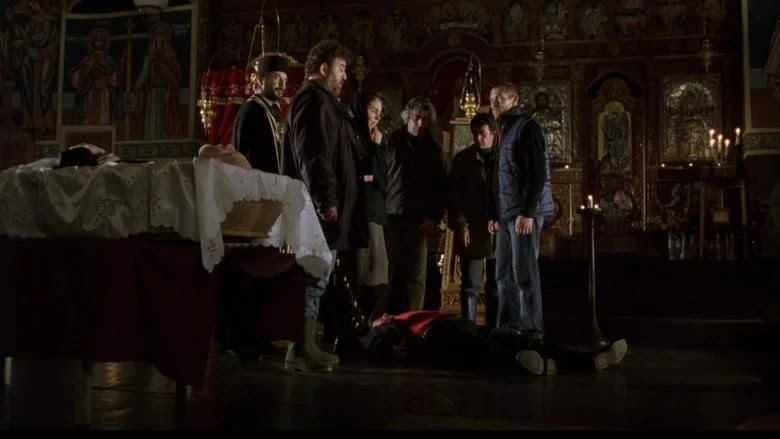
A.k.a. Secret Scandal and Secret Scandal of a Hometown Girl, this possibly lost exploiter film is based on an "original story" by forgotten "automatic" author and scriptwriter Louis Victor Jefferson (14 May 1873 – 30 Nov 1959), and is possibly the last film based on a work of his. Director W. Merle Connell (7 Jan 1905–25 Nov 1963) made this tawdry little thing the same year he made his much more famous (and now in the public domain) anti-classic, Test Tube Babies — which might explain why the character Dr. Wright (Timothy Farrell [26 Jun 1922 – 9 May 1989]) appears in both films. 48-year-old Princess Livingston appears in Hometown Girl as one of the beauty contestants (!).
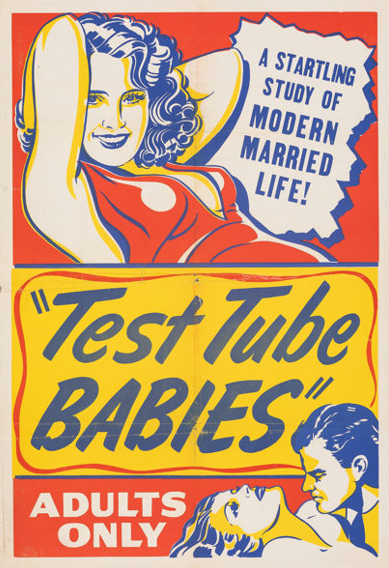
Princess Livingston does not appear in
Test Tube Babies — full film:
The AFI Catalog has a detailed plot description of Hometown Girl: "Lorelei Crawford (Pat Carroll), a manicurist in a beauty shop in a small city, has recently moved to town to begin a new life after leaving her conman husband Dirk (Don Mathers). Crawford traces Lorelei, however, and when he finds out about a prosperous local business, the Turner Soap Co., sees the opportunity to make some money. Posing as a representative of a Chicago advertising firm, Crawford persuades company owner Turner (Tom London [24 Aug 1889 – 5 Dec 1963]) to initiate an advertising campaign based on a talent contest among local amateur performers. The contest winners would appear on a television show sponsored by Turner's company. Crawford also creates a rift between Turner's daughter Nadine (Devvy Davenport [19 Feb 1927 – 17 May 2007]) and her handsome fiancé, Grant Waldron (Morgan Jones [15 Jun 1928 – 13 Jan 2012], of Not of this Earth [1957 / trailer], with Dick Miller), the company sales manager, by overwhelming her with his charm and personality. After Grant discovers that Crawford is a crook and is duping Turner, Grant beats him up. As an act of revenge, Crawford persuades Nadine to elope with him to Las Vegas, even though he has no intention of marrying her. Crawford then fakes a car breakdown that necessitates that they spend the night in a motel, where he seduces her. When Nadine wakes up the next morning, she discovers that Crawford has abandoned her and returns to her forgiving parents, telling them that she changed her mind about marrying Crawford and spent the night in a bus station. Although Nadine and Grant break off their engagement, she continues to help him with the popular talent contest, of which he is now in charge. Meanwhile, Lorelei, who has a background as a singer, is also assisting Grant, and she and Nadine become friends. Time passes and when Nadine suspects that she is pregnant by Crawford, she confides in Lorelei. Lorelei accompanies Nadine to her doctor's office where her pregnancy is confirmed. After the doctor (Timothy Farrell of Jail Bait [1954]), a family friend, advises Nadine to tell her parents and Grant about her condition, Lorelei, without saying anything to Nadine, approaches Grant and tells him about Nadine's dilemma. Grant then tells Nadine that he will stand by her and replaces on her finger the engagement ring she had previously discarded. Later, after Crawford is arrested in another city for engineering a similar scheme, Grant produces the television show to everyone's delight."
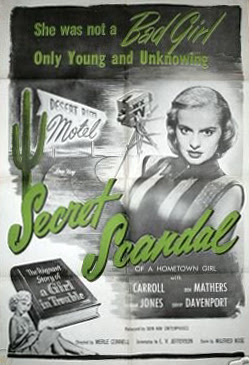
Devvy Davenport, BTW, went on to do a few more appearances and non-appearances in films, but her greatest success lay in songwriting and country singing...

Devvy Davenport sings
Hurtin' the Most:
Wild Gals of the Naked West
(1962, dir. Russ Meyer)
(1962, dir. Russ Meyer)

Are we wrong at seeing a stylistic similarity in the drawings in the above poster and the poster to Barry Mahon's The Beast that Killed Women (1965 — see: B.o.Y. Gigi Darlene Part IV)? Anyone know who the artist was? Wild Gals is a.k.a. The Immoral West. Watch it at the Internet Archives. Russ Meyer's fourth nudie-cutie, and were it not for his third, Erotica (1961), this one would be the one that gets the least respect. A shame, actually. Sure, it's a product of its time and is juvenilely innocent in its sexuality and humor, but not all jokes fall flat on the breasts of the eye-candy women, and the wild art design is a visual treat, too.


The screenplay to Wild Gals was supplied by former kiddy star Jackie Moran (26 Jan 1923 – 20 Sept 1990), who went on to write Meyer's masterpiece Faster, Pussycat! Kill! Kill! (1965, see R.I.P. Haji and R.I.P. Tura Satana) and who also appears in this film as the Old Prospector. Princess Livingston is there as a cackling crazy lady in the saloon (image below). In general, much the film comes across like one extended and very low-budget Day-Glo Benny Hill skit with way more nudity and bigger boobage.

Over at Miss Meyer, where the image above of Princess in the film is taken, Lydia Mitchell says "There are no reports on how [Princess and Russ Meyer] met (one can only imagine...) but [...] credited rather aptly as the 'Scary Woman in Saloon', Livingston cackles and winks her way through the brief scenes she is intercut into. Every town has them (where I live, we had 'Jesus Man'), and Meyer made sure as hell his fictional Western contained a weird older character that everyone knew of and never forgot.'

Some SFW scenes:
Indeed, as Swampflix points out, "Wild Gals of the Naked West tries its best to cultivate a sense of unbridled chaos in shoddy, vaudevillian gags involving gorilla costumes, crossdressing, and pranks involving outhouses, but none of the film's thematic shenanigans can even approach the cinematic lunacy Princess Livingston commands simply by being her wonderful self."

"The first ten minutes or so of Russ Meyer's Wild Gals of the Naked West did not inspire confidence. [...] I think these two scenes were probably added after the fact to bolster the running time because immediately afterwards ANOTHER narrator (this time an onscreen drunk prospector [Moran]) shows up to tell us about the titular women. Fortunately for the audience, things improve drastically from there. Russ keeps the gags and jokes coming at a steady pace. Some are less successful than others, but there are a few hearty laughs to be had. [...] It ultimately doesn't amount to much, but the rest of the movie isn't nearly as terrible as the first ten minutes would suggest. Most of this is so lightweight that it will barely even register. However, if you want to watch a lot of bouncing bosoms in a Wild West setting, Wild Gals of the Naked West should fit the bill. [Video Vacuum]"

(Re)Search My Trash, which sees the movie like "a Tex Avery cartoon come to life", has the "plot": "Today, it's a ghost town, but (if we are to believe our drunk host who claims to have lived that long) a hundred years ago it was a cesspool of sin, where hookers caught their johns by lasso, cowboys, Indians and even gorillas chased topless girls across town, duels were fought that cost few a duelist but many a spectator their lives, there was no law and no morals. But then an unarmed stranger (Sammy Gilbert) in city clothes enters town, and he makes it through all the random duels in his way alive, manages to not be lassoed by the local prostitutes, and even makes it to the bar of the local saloon that's less than friendly to strangers — and thus he catches the eye of the main bargirl Goldie (Terri Taylor) — much to the dismay of her man, bar-owner Snake (Frank Bolger), who's quick to have the stranger thrown out. But the stranger is quick to come back all dressed up as a gunman, and he plays it so cool he makes Snake lose it before he even draws ... and of course he gets the girl in the end."

Bargirl Goldie (Terri Taylor) has a lot of breast appeal, but she is hardly the only one whose cup runneth over: many an unnamed and unknown display their ample assets in the 65-min movie, including the legendary Julie "The Bosom" Williams (b. 30 Nov 1939), a.k.a. Julie Wills, who (going by certain physical traits) dons wigs and sometimes pasties to appear more than once. That's Julie above on the cover of some vintage sleeze, which has also been published as Sex Unlimited. "J.H. Wilkens" is/was actually "pop culture historian" Jim Harmon (21 Apr 1921 – 16 Feb 2010).

Good ol' Temple of Schlock was able to locate a newspaper ad of the movie's original release in 1962 at the now-demolished cinema, The Movie, when the flick was still known as The Immoral West. Co-feature Isle of Levant (1959 / full film) takes a look, after a long and boring travel log getting there from Denmark, at the nudist scene of the island in the days before it became a swinger paradise. A more interesting combination was the triple feature below, where it became part of a three-way with Gregory Corarito's Carnal Madness a.k.a. Delinquent Schoolgirls (1974 / trailer), the only known movie to feature the legendary Roberta Pedon, and Stephanie Rothman's Group Marriage (1972 / trailer below).

Trailer to
Group Marriage:
Heavenly Bodies!
(1963, writ. & dir. Russ Meyer)

Are we wrong at seeing a stylistic similarity in the drawings in the above poster and the poster to Barry Mahon's The Beast that Killed Women (1965 — see: B.o.Y. Gigi Darlene Part IV)? Anyone know who the artist was? We have yet to see this faux-documentary, Russ Meyer's last nudie cutie, which had been out of circulation and completely unavailable for years. No longer. Princess Livingston appears in it, if but briefly, and Swampflix knows how & where: "Although Heavenly Bodies! is by all means Russ' love letter to himself [...] it at least vaguely pretends to be something more significant: a documentary on nude photography as a business. An early reenactment in the film retraces 'glamour photography' back 30 years to stage a silent film shoot on the beach featuring Meyer vet Princess Livingston rolling around in a swimsuit. Anyone familiar with the elderly Princess Livingston's toothless, maniacal screen presence [...] should have a ball picturing the lovable coot sarcastically pretending to vamp it up for the camera."

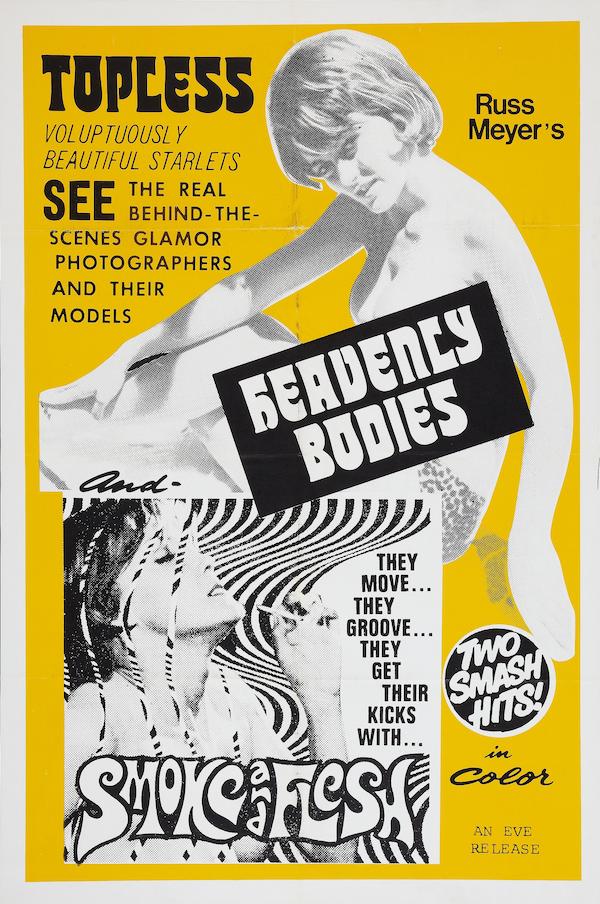
AFI has a synopsis, one that is far more serious than the extended short film deserves: "A behind-the-scenes look at the world of figure modeling shows Hollywood 'glamour' photographers at work with both professional and novice models. Ken Parker works with two models at the same time so as to afford each of them more rest, and to provoke an atmosphere of spontaneous interplay. Russ Meyer, 'one of Hollywood's best known glamour photographers', leads a group of his friends, former Army Signal Corps cameramen, on an outing to demonstrate the value of the photo field trip in 'glamour' photography. In the woods, models Althea [Currier] and Monica [Liljistrand] pose nude for a series of nature shots. Back in Hollywood, a 21-year-old aspiring showgirl, Rochelle Kennedy, arises early for a modeling session with Charles Gilbert Schelling (5 Oct 1919 – 25 Jan 1971), who skillfully encourages her into the desired frame of mind. Russ Meyer shows his ability to elicit dynamic emotion and drive from his models. Photographer Don Goodwin demonstrates his knack for recruiting new models. He spots the striking Ivana Nolte on a Los Angeles street, convinces her of his honorable intentions, offers the promise of a profitable venture, tests her ability to pose, and puts his early appraisal of her figure to a more rigorous scrutiny. He then meets the challenge of convincing Ivana to release her inhibitions."

The "name" boobage of Heavenly Bodies! is undeniably the then 22-year-old glamour model Althea [Delma] Currier. "Currier was supposedly born in England but raised in Woodland, Maine. She moved to Southern California and worked as a dance instructor for almost two years at a studio on the Sunset Strip with a partner named Jack Simmons. [...] Althea supposedly worked as chorus girl in San Francisco for a while. Althea was then supposedly 'discovered' by Chuck Landis, who was the owner of the Largo Strip Club in L.A. This led to Althea becoming involved in glamour/nude modeling; she appeared in many magazines of the era, including Mosaic, Modern Man, Adam, Scamp, All Man, etc. She is also featured in Adam magazine's 1964 full-color calendar. Althea wrote an advice column in Adam magazine from 1964 to 1967, and appeared in occasional layouts in the magazine. [Boobpedia]" That's her below, being very French in what looks like a Californian desert landscape...

Other films that Althea appeared in include Knockers Up (1963, see Harry Novak, Part II) and the early classic Meyer's roughie, Lorna (1964 / trailer). Soon after the release of her final and perhaps sleaziest film, the art-house exploiter The Girls on F Street (1966 / full film), poster below, she married — depending on your source — either Dialdas Tharumal Khemlani (3 Feb 1938 – 18 Mar 1997) or George M. Turner and retired to raise a family.

BTW: The title The Girls on F Street was recycled in 1986 for a D2V hand helper with a typical porn plot: "A struggling musician comes up with the perfect song: any woman who hears it immediately turns into an insatiable sex maniac."

Preceding that, however, the title Heavenly Bodies was also recycled, in 1984, for a really stupid Flashdance (1983) rip-off — as if Flashdance weren't stupid enough.

Mudhoney
(1965, dir. Russ Meyer)


"One man's evil can become the curse of all."

Mudhoney:
A.k.a. Rope of Flesh and Mudhoney... Leaves a Taste of Evil! It may be Meyer's preceding roughie, Lorna (1964), and his subsequent film, Faster Pussycat! Kill! Kill! (1965 / trailer, see R.I.P. Haji and R.I.P. Tura Santana), that get all the attention, but here at a wasted life we have always found this sweaty and violent slab of period-set, melodramatic hixploitation to be the best of Meyer's three roughie classics.

Princess Livingston (above from the film) is on hand for what is probably her largest role in any movie ever, a full ten minutes of screen time as Maggie Marie, the white-trash mother of the local cathouse housing pneumatic good-time gal Clara Belle (Lorna Maitland) and her equally pneumatic deaf and dumb sister Eula (Rena Horten [11 Feb 1941 – 11 Nov 2009] of Out of Sight [1966 / trailer], Russ Meyer's Fanny Hill [1964 / trailer] and Sherlock Holmes and the Deadly Necklace [1962]). That's Rena on the poster below.

The film was a financial failure, and Meyer later said it was a mistake that he only made because he was in love with Rena Horton; Robert Ebert, on the other hand, saw Mudhoney as Meyer's "most interesting, most ambitious, most complex" neglected masterpiece. We agree with Ebert 100% and are happy that Meyer fell in love with Rena Horton's breasts. Had he not, this film might never have been made.
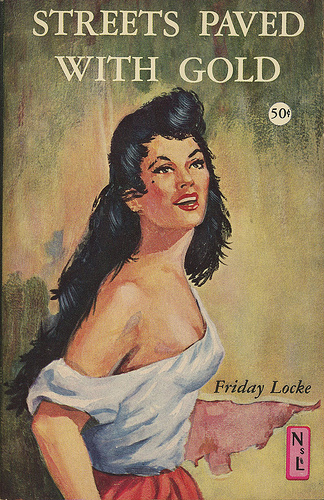
Mudhoney is based on an obscure novel titled Streets Paved with Gold by Raymond Friday Locke (1934 – 8 June 2002), who co-wrote the screenplay with William E. Sprague, the latter of whom went on to script Meyer's non-classic Motorpsycho (1965, see R.I.P. Haji).

The plot, as supplied by Fred Beldin at All Movie: "California McKinney (John Furlong [14 Apr 1933 – 23 Jun 2008] of Vampires [1998]) is hitchhiking to the state he was named for after serving a five-year sentence for manslaughter. He runs out of money in Spooner, MO, and finds work at a farm run by Lute Wade (Stuart Lancaster [30 Nov 1920 – 22 Dec 2000]) and his niece, Hannah Brenshaw (Antoinette Christiani). All Calif wants is to do is work quietly until he can save enough money to keep on moving, but Hannah's drunken husband, Sidney (Hal Hopper [11 Nov 1912 – 2 Nov 1970]), takes it upon himself to verbally and physically abuse him, as he does his own wife and anyone else who crosses his path. Sidney spends most of his time drinking corn liquor at the local whorehouse and bragging about his plans to sell the farm after the sickly Uncle Lute dies. However, the goodhearted Calif and the long-suffering Hannah are falling in love, and Lute arranges his will so that Sidney can't lay claim to the estate after his death. The desperate Sidney plots with the local preacher (Franklin Bolger) to exploit the small town's gossipy nature with lies about Hannah's virtue, though his conniving is undone when he commits an insane, jealous crime and finds himself the target of a bloodthirsty vigilante group."

"[A] raw, unflinching drama taking mob mentality, religion, law, and more to task, says Silver Screening Room, "More than exploitation, it explores the effect change and crisis can have on individuals and groups. The Depression turns a small town into a pressure cooker of violence, everyone waiting for that moment when they can let loose and sacrifice someone, anyone, to the great god Fury. That's mob mentality, but Mudhoney also explores the desperation of families, the injustice done to workers, and the deep holes many buried themselves in when the work dried up. And still has time for sex jokes!" And for boobs, too.

Mudhoney is a movie well worth searching out and watching. It deserves a better fate than simply being known as the source of a cult rock band's name.

Pufnstuf
(1970, dir. Hollingsworth Morse)

"The Krofft Brothers [...] have a showbiz story that dates back to the final days of vaudeville. But for children of the Nixon years, their name is the brand behind some of the era's strangest TV programming: shows such as H.R. Pufnstuf (1969), Lidsville (1971-73 / opening), Land of the Lost (1974-77 / first episode) and Sigmund and the Sea Monsters (1973-75 / opening). [...] Those low-budget shows had rubber-costumed actors, fluorescent puppets and psychedelic sets that were by the 1980s hopelessly dated [...]. [LA Times]"
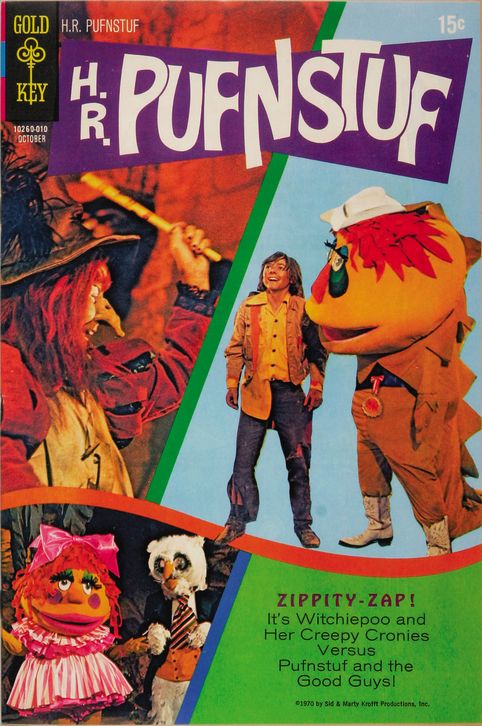
Maybe people were more innocent back then, or maybe people were willfully blind, but it is difficult to see Krofft Brothers' production like this one without thinking that all the people involved in making this movie (and the show that preceded it) were puffin' stuff... lids and lids of stuff, most likely.
Trailer to
Pufnstuf:
"Pufnstuf – The Movie (1970) was released after the TV series. Like Batman (1966 / trailer) and Munsters – Go Home (1966 / trailer), this was cashing in on the success of the TV series. It's not a sequel though, it goes back to the very start and retells the story of how Jimmy (Jack Wild [30 Sept 1952 – 1 Mar 2006]) gets to Living Island and meets Mayor Pufnstuf (Roberto Gamonet [28 Jul 1923 – 16 Oct 1982]), the talking dragon. A few jokes are recycled from the series, but mostly it's all new stuff. Jimmy tries new ways to escape the island, but the wicked witch Witchiepoo (Billie Hayes [5 Aug 1924 – 29 Apr 2021]) thwarts his attempts. She wants to get his magic golden flute, in time for when all the witches in witchdom arrive for a convention in honour of their leader, Boss Witch (Martha Raye [27 Aug 1916 – 19 Oct 1994], of Hellzapoppin' [1941, see Three Dance Scenes] and Monsieur Verdoux [1947 / trailer])! [Black Hole]"

Pufnstuf features the only silver screen (as in feature film) appearance of Cass Elliot (of the original Mamas and the Papas). As for Princess Livingston, she's credited as playing Miss Flick.
Theme song to
H.R. Pufnstuf:
Simon & Garfunkel sing
The 59th Street Bridge Song (Feelin' Groovy):

Daughters of Satan:
Another show developed by the Krofft Brothers that some post-Baby Boomers might remember was Hanna-Barbera Productions' kiddie show, The Banana Splits (1968), which finally made it to the big screen in 2019 as a splatter film.

The Banana Splits reboot:
Beyond the Valley of the Dolls
(1970, dir. Russ Meyer)

Beyond the Valley of the Dolls:
Everything you need to know about this movie is at the top of this blog entry. Princess Livingston makes her last appearance in a Russ Meyer film wearing a day-glow orange wig at the famous wigged-out party at the start of the movie — you see her a few times in the trailer.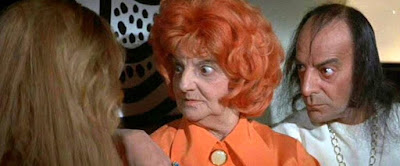
The Unholy Rollers
(1972, dir. Vernon Zimmerman)

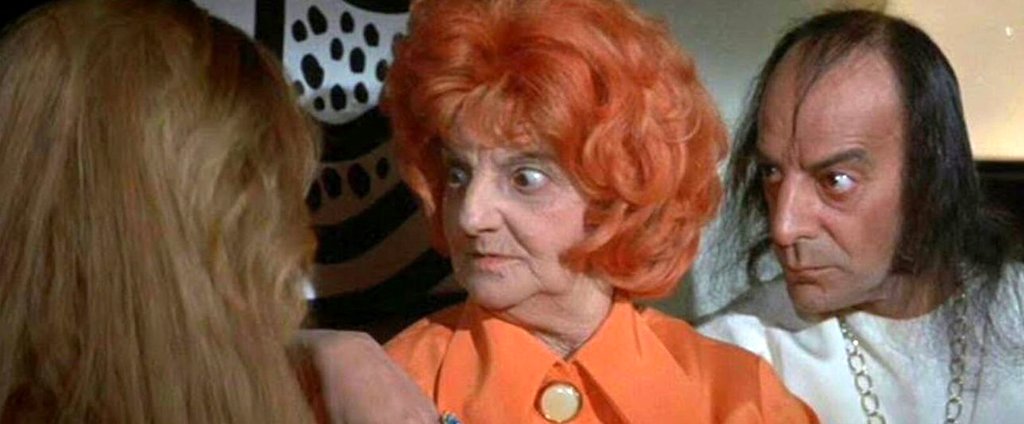
Princess Livingston is there (uncredited) as the Woman in Crowd (below) who utters some of the first words of the movie: "Kill the muthafucker!" As far as we could discern, this is her last known film appearance. Anyone out there know better?

The star of the show, of course, is Playboy's Playmate of the Year of 1970: "Mary Eileen Chesterson (20 Dec 1949 – 3 Oct 1979, see Uschi Part VII and R.I.P. Richard Lynch) was born in Evanston, Illinois in 1949 but was raised mostly around Milwaukee. Just before her twentieth birthday she moved to Chicago and got a job at the Playboy offices as a receptionist. It wasn't long after that the extraordinarily beautiful red-head was noticed, and her first appearance in the magazine came in November of 1969 under the name of Claudia Jennings. [Moon in the Gutter]" Yes, that is her directly below.

"Cranked out quickly to cash-in on MGM's Raquel Welch hit Kansas City Bomber (1972 / trailer), the Roger Corman production The Unholy Rollers is a meaner, grittier look at the world of Roller Derby. [...] The Unholy Rollers doesn't really break any new ground as far as these kinds of stories go, and gets off to a slow start, but director Vernon Zimmerman [...] and veteran Corman screenwriter Howard R. Cohen eventually find their groove. [Good Efficient Butchery]"

Trailer to
Unholy Rollers:
Plot: "Claudia Jennings, the lovely former Playboy Playmate of the Year who starred in a handful of '70s B-movies before dying in a 1979 car accident at the age of 29, plays Karen Walker, a factory worker who quits her job and then seeks employment with a Los Angeles roller-derby team. Ballsy and tough, Karen quickly proves herself a formidable and unpredictable athlete, knocking down competitors with kicks and punches at top speed. Thanks to her good looks, Karen scores a number of endorsement deals even as she competes with the team's former top player, Mickey (Betty Ann Rees of Sugar Hill [1974 / trailer], Deathmaster [1972 / trailer] and The Photographer [1974 / full film]), and watches a new would-be star, Beverly (Charlene Jones of The Curious Female [1970 / opening titles], Trouble Man [1972 / trailer], The Woman Hunt [1972 / full film] and Avenging Angel [1985, see Susan Tyrrell]), gain traction. The threadbare narrative also includes Karen's friendship with two buddies from her factory days, as well as her romantic involvement with a married man (Jay Varela [7 Jul 1937 – 24 Jun 2021]). [Every 70s Movie]"

1000 Misspent Hours "can scarcely begin to communicate how much fun The Unholy Rollers is. From its schlocky premise, to its outrageous sense of humor, to its exuberantly inept execution, it truly is one of the grandest achievements of early-70s' American exploitation. This is one of those rare trash movies that is just as funny when it's trying to be as it is by accident. That no one in this film can act worth a damn, and that the soundtrack originally recorded came out so bad that only half of it could be used (the rest of the dialogue was looped later, sometimes by different actors than had spoken the lines originally!) is hilarious, but so are the spot-on parodies of 70s' TV commercials, TV and radio sports commentary, and scripted, staged 'athletic' contests. There's even an extremely witty bit before the opening credits that is almost certainly a dig at the film's notoriously tight-fisted executive producer."

Scriptwriter Howard R. Cohen [12 Aug 1942 – 3 Apr 1999] also did the screenplay to Vampire Hookers (1978, see Movie Music) and directed the less-than-spectacular Space Raiders (1983). The man behind the "exuberantly inept execution" of the film, Vernon Zimmerman, is still alive but has left the biz for academia. Before leaving, he managed to write Hex (1973 / scene) and Bobbie Jo and the Outlaw (1976 / trailer), the latter mildly famous for displaying Lynda "Wonder Woman" Carter's bodacious boobs, and made one of the more interesting slashers of the Golden Age, Fade to Black (1980 / trailer).

Background Babe of
Beyond the Valley of the Dolls –
Till then — guys: tan those testicles!