

2 August
1939 — 30 August 2015
What follows is Part II of a look at some the projects he was involved in — actually and/or presumably. TV series are ignored.
Go here for Part I (1970-77).

Stranger
in Our House
(1978, dir. Wes
Craven)
Aka Summer of Fear, Stranger in Our House
is based on the teen novel Summer of Fear by Lois Duncan, who also
wrote the novel behind I Know What You
Did Last Summer (1997 / trailer).


Wes Craven's first television movie, like all his TV movies, is generally not
viewed fondly by those who have seen it — as is the case at Classic Horror,
which couldn't stop thinking of cabbage while watching the movie and says
"Summer of Fear
[...] is one of those times when even the master fails". (The master failed often, actually.)

The plot, according
to Cult Reviews: "When Julia Trent's (Lee Purcell, also seen somewhere in The Witching
[1972]) parents are killed in an accident, she comes to live
with her aunt Leslie Bryant (Carol Lawrence)
and uncle Tom (Jeremy Slate). At
first daughter Rachel (Linda Blair of Hell Night
[1981]) accepts Julia as a new friend while her older brother
Peter (Jeff East) lusts after Julia
and her younger brother Bobby (James Jarnigan)
doesn't seem to notice. When Rachel's horse hates Julia and Julia steals
Rachel's boyfriend Mike Gallagher (Jeff McCracken)
and her best friend Carolyn Baker (Fran Drescher),
Rachel starts to suspect that her cousin is more than just a bitch…."
 The Bloody Pit of Horror
is of the opinion that "At the time, director Wes Craven was best known
for the gritty, violent shockers [...], so this milder made-for-TV effort
marked both a change of pace for him as well as a (more-or-less) successful
step toward mainstream acceptance. On the other hand, actress Linda Blair [...] was just ending her reign as teen queen
of the controversial tele-movie. Prior to this, she'd played a teenage
alcoholic, a kidnapped illiterate teen, a sickly teen awaiting a kidney
transplant aboard a doomed aircraft, a institutionalized juvenile delinquent
who gets pinned down and raped with a broom handle and other roles that make
what goes down in this horror flick look a little tame by comparison. So I'd
say this one probably helped Craven's career but really didn't do a whole lot
for Blair's. Either way, within the limitations of the TV movie, it's really
not a bad little effort."
The Bloody Pit of Horror
is of the opinion that "At the time, director Wes Craven was best known
for the gritty, violent shockers [...], so this milder made-for-TV effort
marked both a change of pace for him as well as a (more-or-less) successful
step toward mainstream acceptance. On the other hand, actress Linda Blair [...] was just ending her reign as teen queen
of the controversial tele-movie. Prior to this, she'd played a teenage
alcoholic, a kidnapped illiterate teen, a sickly teen awaiting a kidney
transplant aboard a doomed aircraft, a institutionalized juvenile delinquent
who gets pinned down and raped with a broom handle and other roles that make
what goes down in this horror flick look a little tame by comparison. So I'd
say this one probably helped Craven's career but really didn't do a whole lot
for Blair's. Either way, within the limitations of the TV movie, it's really
not a bad little effort."
 Stranger in Our House was subsequently released theatrically in Europe under the title of
its source novel, Summer of Fear, which it then retained
for its video release.
Stranger in Our House was subsequently released theatrically in Europe under the title of
its source novel, Summer of Fear, which it then retained
for its video release.

 The imdb
lists Craven as the cinematographer of this mockumentary, but they have it
wrong: his only link to this flick is the inclusion of previously unseen
outtakes — presented as a "real" snuff scene — from Craven's masterful
horror debut, The Last House on the Left (1972).
The imdb
lists Craven as the cinematographer of this mockumentary, but they have it
wrong: his only link to this flick is the inclusion of previously unseen
outtakes — presented as a "real" snuff scene — from Craven's masterful
horror debut, The Last House on the Left (1972).

 Claudia Fielers
(21 May 1946 – 20 February 1975), the young actress and suicide by
poison featured in Snuff who seems
to have killed herself following an argument with the director Robert Furch, had bit parts in a variety of fun German
sleaze, including numerous Schoolgirl
Report films, Erwin C. Dietrich's
Die Mädchenhändler
/ White Slavers
(1972), Dietrich's She-Devils of the S.S. (1973), and Joseph W. Sarno's Der Fluch der schwarzen
Schwestern / The Devil's Plaything
(1973 / scene).
Claudia Fielers
(21 May 1946 – 20 February 1975), the young actress and suicide by
poison featured in Snuff who seems
to have killed herself following an argument with the director Robert Furch, had bit parts in a variety of fun German
sleaze, including numerous Schoolgirl
Report films, Erwin C. Dietrich's
Die Mädchenhändler
/ White Slavers
(1972), Dietrich's She-Devils of the S.S. (1973), and Joseph W. Sarno's Der Fluch der schwarzen
Schwestern / The Devil's Plaything
(1973 / scene).

Deadly Blessings
 For that, we
totally loved the lead actress, Maren Jenson, who is 100% total babe-a-luscious;
regrettably, she left the film business soon after due to illness. Another plus
to the movie is the typically over-the-top, scenery-chewing Ernest Borgnine as
the leader of the Hittite community in which the film is set; the Hittites of
the film, who "make the Amish look like swingers", naturally don't
exist in real life but are modeled after the real-life Amish and Hutterite.
For that, we
totally loved the lead actress, Maren Jenson, who is 100% total babe-a-luscious;
regrettably, she left the film business soon after due to illness. Another plus
to the movie is the typically over-the-top, scenery-chewing Ernest Borgnine as
the leader of the Hittite community in which the film is set; the Hittites of
the film, who "make the Amish look like swingers", naturally don't
exist in real life but are modeled after the real-life Amish and Hutterite.
 Time has been kind to the movie, and nowadays it even enjoys some popularity as
one of Craven's better films. Final Girl,
however, is of a mixed mind, saying many things but most importantly:
"It's kind of a seven-layer dip of a movie: all these different flavors
competing with each other but trying to work together, turning into a big mess
that sits in your stomach like a gelatinous lump of regret. Mind you, the
regret comes later; while you're eating it, your eyes focus on some distant,
imaginary point and you find yourself saying a little too loudly, 'I don't know
what's happening to me and I'm not sure if I entirely like it, but I might and
so I'll just keep going.' Yes, in this way Deadly Blessing is exactly
like a seven-layer dip. [...] But then...the last ten minutes. I'm not going to
give away anything here, because...the last ten minutes of this film should not
be given away. Let me just say that it's jaw-dropping. It is women punching,
shooting, flying around due to punches and/or gunshots, and making crazy faces.
It is a big pile of total what-the-fuckery, and it completely redeems all that
came before. And just when you think it is over, it is not. And then
your jaw — still dropped! — will say 'fuck this' and throw itself out your
window. It's amazing." (Stacey obviously likes the ending we so
hate.)
Time has been kind to the movie, and nowadays it even enjoys some popularity as
one of Craven's better films. Final Girl,
however, is of a mixed mind, saying many things but most importantly:
"It's kind of a seven-layer dip of a movie: all these different flavors
competing with each other but trying to work together, turning into a big mess
that sits in your stomach like a gelatinous lump of regret. Mind you, the
regret comes later; while you're eating it, your eyes focus on some distant,
imaginary point and you find yourself saying a little too loudly, 'I don't know
what's happening to me and I'm not sure if I entirely like it, but I might and
so I'll just keep going.' Yes, in this way Deadly Blessing is exactly
like a seven-layer dip. [...] But then...the last ten minutes. I'm not going to
give away anything here, because...the last ten minutes of this film should not
be given away. Let me just say that it's jaw-dropping. It is women punching,
shooting, flying around due to punches and/or gunshots, and making crazy faces.
It is a big pile of total what-the-fuckery, and it completely redeems all that
came before. And just when you think it is over, it is not. And then
your jaw — still dropped! — will say 'fuck this' and throw itself out your
window. It's amazing." (Stacey obviously likes the ending we so
hate.)
 Cult Movies has a more literal plot description of the film they call "a bizarre, creepily effective tale":
"The story takes place in a farming community and centers on a
young woman named Martha (Maren Hensen), who has married a member of the
Hittites (Jeff East), a cult sect who live nearby
and are run by the unflappable Patriarchal figure of Isaiah Schmidt (Borgnine).
Isaiah has turned his back on his son due to his belief that Martha is an
Incubus in legion with the Devil. When Martha's husband is mysteriously killed
one night by his own tractor, her two female friends come to stay with her and
console her over her loss. [...] When the two ladies arrive at Martha's house,
things start going from bad to worse, with locals being killed off by an
unknown assailant and Isaiah insisting that Martha is responsible for the death
of one of the Hittites. Meanwhile some of the other locals are hiding secrets
of their own. Deadly Blessing is a
consistently intriguing horror mystery which showcases director Wes Craven's
skills to fine effect [...]".
Cult Movies has a more literal plot description of the film they call "a bizarre, creepily effective tale":
"The story takes place in a farming community and centers on a
young woman named Martha (Maren Hensen), who has married a member of the
Hittites (Jeff East), a cult sect who live nearby
and are run by the unflappable Patriarchal figure of Isaiah Schmidt (Borgnine).
Isaiah has turned his back on his son due to his belief that Martha is an
Incubus in legion with the Devil. When Martha's husband is mysteriously killed
one night by his own tractor, her two female friends come to stay with her and
console her over her loss. [...] When the two ladies arrive at Martha's house,
things start going from bad to worse, with locals being killed off by an
unknown assailant and Isaiah insisting that Martha is responsible for the death
of one of the Hittites. Meanwhile some of the other locals are hiding secrets
of their own. Deadly Blessing is a
consistently intriguing horror mystery which showcases director Wes Craven's
skills to fine effect [...]".

Director Goldstone (8 June 1931 – 5 November 1999) was the man behind the second pilot of the original Star Trek series (1966-69), Where No Man Has Gone Before, which was then later broadcast as the third episode (22 Sept. 1966), when the first pilot, The Cage (1965), failed to impress NBC.
 Click the title above to go to our typically verbose review of the
movie, which we found flawed but rather enjoyable. Seven years later, bad guy Dr. Anton Arcane (Louis Jourdan) and
Swampy (Dick Durock) returned for the far more trashy The Return of Swamp Thing (trailer),
directed by Jim Wynorski.
Click the title above to go to our typically verbose review of the
movie, which we found flawed but rather enjoyable. Seven years later, bad guy Dr. Anton Arcane (Louis Jourdan) and
Swampy (Dick Durock) returned for the far more trashy The Return of Swamp Thing (trailer),
directed by Jim Wynorski.

Trailer:

 Ninja Dixon,
which calls the flick "one of the dumbest
sequels produced" and says "it's like
director/writer Craven just didn't give a shit [about] what was going on", nevertheless confesses to enjoying it. He points out
the best things about the movie: "Everything in this movie is SO
stupid. It's hard to even imagine how stupid it is if you haven't seen it. From
the legendary 'dog-having-a-flashback'-scene to one of the female characters
suddenly taking an outdoor shower because 'she can't miss a chance like this',
and this is in the middle of the night when something fishy obviously is
happening around them, her friends disappearing etc. I also need to mention
that the final girl is blind, but actually walks around and escapes the family
over and over again like she actually can see very, very good!"
Ninja Dixon,
which calls the flick "one of the dumbest
sequels produced" and says "it's like
director/writer Craven just didn't give a shit [about] what was going on", nevertheless confesses to enjoying it. He points out
the best things about the movie: "Everything in this movie is SO
stupid. It's hard to even imagine how stupid it is if you haven't seen it. From
the legendary 'dog-having-a-flashback'-scene to one of the female characters
suddenly taking an outdoor shower because 'she can't miss a chance like this',
and this is in the middle of the night when something fishy obviously is
happening around them, her friends disappearing etc. I also need to mention
that the final girl is blind, but actually walks around and escapes the family
over and over again like she actually can see very, very good!"
The plot? Some survivors of the first film go back the location of the first film with some other new fodder to ride dirt bikes and run into the surviving cannibals of the first film (and a few new ones) and everyone has a lot of flashbacks and some people die. Avoid this one like you would Donald Trump's unwashed anus.

A Nightmare on Elm Street
Odd how the cookie crumbles: the same year that Craven makes and
releases The Hills Have Eyes Part II,
one of the worst films ever made, he also makes and releases one of the true
classics of modern horror, A Nightmare
on Elm Street. Inspired by news reports about "Asian Death Syndrome",
basically a form of Brugada Syndrome,
Craven came up with one of the iconic characters of horror, Freddy, and created
this masterpiece.
 Aside from creating a bona fide classic, Craven could actually claim
to be the one to have discovered Johnny Depp, who made his screen debut in the
movie. (Truth be told, Craven could probably also claim to having made Robert
Englund's career, too, for although he had been around for a long time, he only
became a name after this movie.) Although it has little to do with the movie,
we must admit here that after it came out, we occasionally dreamt of a
three-way with Depp and the true star of the movie, Heather Langenkamp —
believe us, it was never a nightmare.
Aside from creating a bona fide classic, Craven could actually claim
to be the one to have discovered Johnny Depp, who made his screen debut in the
movie. (Truth be told, Craven could probably also claim to having made Robert
Englund's career, too, for although he had been around for a long time, he only
became a name after this movie.) Although it has little to do with the movie,
we must admit here that after it came out, we occasionally dreamt of a
three-way with Depp and the true star of the movie, Heather Langenkamp —
believe us, it was never a nightmare.

 A Nightmare on Elm Street remains a film, like such classics as Frankenstein (1931 / trailer)
or The Haunting (1963 / trailer)
or Night of the Living Dead
(1968 / trailer), that is
required viewing of anyone that claims to be a horror movie fan.
A Nightmare on Elm Street remains a film, like such classics as Frankenstein (1931 / trailer)
or The Haunting (1963 / trailer)
or Night of the Living Dead
(1968 / trailer), that is
required viewing of anyone that claims to be a horror movie fan.


 Though nominated
for a lesser Emmy ("Outstanding Art Direction"), few people who have
seen Invitation to Hell have
anything nice to say about it. In the opinion of Cult Reviews,
for example, "Wes should be ashamed of himself [for having made this
movie]." Here at A Wasted Life,
however, we personally we find the movie wonderfully stupid and entertainingly
cheesy.
Though nominated
for a lesser Emmy ("Outstanding Art Direction"), few people who have
seen Invitation to Hell have
anything nice to say about it. In the opinion of Cult Reviews,
for example, "Wes should be ashamed of himself [for having made this
movie]." Here at A Wasted Life,
however, we personally we find the movie wonderfully stupid and entertainingly
cheesy.
Camp Blood,
one of the few who has anything nice to say about the TV movie, knows the
facts: "This [...] has absolutely everything from white-hot tract houses
to evil children to laser-shooting space suits to computers to demonic
possession to late-seventies corporate angst to Susan Lucci in chandelier
earrings as the devil incarnate, who happens to work at a country club. A
surprisingly lucid and well-constructed parable about selling out to, well —
just about anything (greed, lust, corporate America), Invitation to Hell is surprisingly well-told for a story that is so
aggressively weird and composed of such disparate genre elements (horror,
sci-fi, family drama, corporate thriller, satire). Craven's hand is certainly
visible at the helm; as with his later work, the fantastic is planted so firmly
in a banal suburban setting that it's both shocking and surprisingly fitting
(much like A Nightmare on Elm Street).
Lucci is absolutely riotous as alpha-bitch Jessica Jones; the fact that the
devil would take the form of a slutty membership director at a barren country
club is simply brilliant in its inanity, and she plays the part so straight
it's impossible to tell if she was in on the joke or not. Building a very effective
story on a simple Stepford-like premise of 'belonging', the film culminates in
a special effects extravaganza of monumentally trashy proportions (much of
which involves Lucci's makeup)."
The plot, when
reduced to its skimpiest form: "Matt Winslow (Robert Urich, 19 December
1946 — 16 April 2002, of Killdozer
[1974 / trailer]),
wife (Joanna Cassidy of The Night Child
(1975 / trailer)
and Blade Runner [1982 / trailer])
and family move to a town named Steaming Springs to start a new life, where the
devil temps the worldly at the local country club. Luckily, Matt has a
spacesuit."

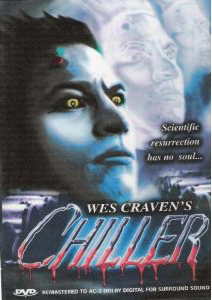
 We saw this one, and we were not amused. Click the title above to
read our typically verbose review from 2007, which ends with the following
statement: "A truly awful film with no
redeeming features, Chiller won't do much more than leave you pissed-off
for having wasted your time. Indeed, seldom is there a movie that improves with
the inclusion of commercials, but Chiller stands out as one such
production."
We saw this one, and we were not amused. Click the title above to
read our typically verbose review from 2007, which ends with the following
statement: "A truly awful film with no
redeeming features, Chiller won't do much more than leave you pissed-off
for having wasted your time. Indeed, seldom is there a movie that improves with
the inclusion of commercials, but Chiller stands out as one such
production."
 Maynard's Horror Movie Diary
has the basic plot and a similar opinion: "Chiller is a weird and underwhelming made-for-TV thriller about a
cryogenetically frozen body that comes back to life as soulless and callous
killer. The basic storyline is pretty intriguing and the first 20 minutes are
eerie and chilling, especially the opening sequence, but due to Wes Craven's
extremely poor direction and the lengthy script of J.D. Feigelson, the movie
lacks tension and thrills, and is loaded with tedious and tiresome scenes,
including one of the lamest climaxes in Craven's filmography."
Maynard's Horror Movie Diary
has the basic plot and a similar opinion: "Chiller is a weird and underwhelming made-for-TV thriller about a
cryogenetically frozen body that comes back to life as soulless and callous
killer. The basic storyline is pretty intriguing and the first 20 minutes are
eerie and chilling, especially the opening sequence, but due to Wes Craven's
extremely poor direction and the lengthy script of J.D. Feigelson, the movie
lacks tension and thrills, and is loaded with tedious and tiresome scenes,
including one of the lamest climaxes in Craven's filmography."
 J.D. Feigelson,
as "Jake Fowler", also scripted the cheapo, regional horror trash
classic Horror High (1974), a far
more entertaining movie than Chiller.
J.D. Feigelson,
as "Jake Fowler", also scripted the cheapo, regional horror trash
classic Horror High (1974), a far
more entertaining movie than Chiller.

 Craven was actually approached to do Part II but he turned it down due to a variety of reasons, so the
project went to Jack Sholder, who three years earlier had made the still
underappreciated horror, Alone in the Dark (1982 / trailer),
which, in all truth, is a better movie than this one.
Craven was actually approached to do Part II but he turned it down due to a variety of reasons, so the
project went to Jack Sholder, who three years earlier had made the still
underappreciated horror, Alone in the Dark (1982 / trailer),
which, in all truth, is a better movie than this one.

 We admit to watching about a half hour of Deadly Friend on VHS one evening — and popping it out of the player
for something better (don't remember what it was we watched instead, but it was
better). One of Craven's more problematic productions — literally: the studio
more or less forced him to make a film he didn't want to make from a film that
he had made like he had wanted to make. Deadly
Friend, made while Craven was in the midst of his
I-don't-want-to-be-just-a-horror-movie-director phase, was intended by the
director to be more of a sci-fi relationship dramatic thriller along the lines
of John Carpenter's dull Starman (1984
/ trailer),
but, damn it! The movie studio wanted a "Craven movie", with blood
and gore and horror, and that is what they made sure they got. The movie's
ending is particularly hated, but as Bruce Joel
Rubin has famously said, "That robot coming out of girl's head belongs
solely to Mark Canton, and you don't tell the [then] president of Warner Bros.
that his idea stinks!"
We admit to watching about a half hour of Deadly Friend on VHS one evening — and popping it out of the player
for something better (don't remember what it was we watched instead, but it was
better). One of Craven's more problematic productions — literally: the studio
more or less forced him to make a film he didn't want to make from a film that
he had made like he had wanted to make. Deadly
Friend, made while Craven was in the midst of his
I-don't-want-to-be-just-a-horror-movie-director phase, was intended by the
director to be more of a sci-fi relationship dramatic thriller along the lines
of John Carpenter's dull Starman (1984
/ trailer),
but, damn it! The movie studio wanted a "Craven movie", with blood
and gore and horror, and that is what they made sure they got. The movie's
ending is particularly hated, but as Bruce Joel
Rubin has famously said, "That robot coming out of girl's head belongs
solely to Mark Canton, and you don't tell the [then] president of Warner Bros.
that his idea stinks!"
 Needless to say, the flick flopped and is not considered one of
Craven's successful projects — but They Shoot Actors, Don't They
is not one of the nay-sayers, and considers the movie "one of the more enjoyable Wes Craven movies",
saying that some of the reasons the film is good are because "BB
the robot talks like a retarded Jawa, Kristie Swanson wears blue eye shadow
around her eyes to show that she's resurrected, and it has a wonderfully
ridiculous ending."
Needless to say, the flick flopped and is not considered one of
Craven's successful projects — but They Shoot Actors, Don't They
is not one of the nay-sayers, and considers the movie "one of the more enjoyable Wes Craven movies",
saying that some of the reasons the film is good are because "BB
the robot talks like a retarded Jawa, Kristie Swanson wears blue eye shadow
around her eyes to show that she's resurrected, and it has a wonderfully
ridiculous ending."
The plot as
supplied by Richard Scheib at the Science Fiction, Horror and Fantasy Film Review:
"Teen genius Paul Conway (Matthew Labyorteaux)
and his divorced mother (Anne Twomey) move into a new neighborhood so that Paul
can teach computer science at the local polytechnic while also studying for his
medical degree. Paul befriends and falls for Samantha Pringle (Kristy Swanson of Highway to Hell
[1992] and The Phantom
[1996]), the girl next door. He is
upset when Dee-Dee, the beloved robot he has built, is blasted to pieces with a
shotgun by crazy old neighbour Elvira Parker (Anne
Ramsey, 1 September 1929
— 11 August 1988) during a Halloween
prank. When Samantha's father (Richard Marcus
of Tremors
[1990]) catches her and Paul kissing,
he brutally beats Samantha, sending her falling down a set of stairs and
leaving her in a coma. After the medics turn the life support machines off,
Paul comes up with a crazy idea to save Samantha by stealing her body,
implanting Dee-Dee's computer chip in her brain and using it to restore her to
life."


8
Minutes of
Summer of Fear:

The
Evolution of Snuff
(1978, dir. Andrzej
Kostenko)
Aka Confessions of a Blue Movie Star and Snuff; not to be
confused with Michael Findlay's (1938 – 16 May 1977) legendary exploiter from
1976 (trailer) that started the whole scandal and legend, Snuff — "A film that could only be made in South America,
where life is CHEAP!"

Scenes from
The Last House on the Left
The Last House on the Left
presented as real snuff scenes:
BFI
explains the movie's supposed agenda: "[The movie]
sets out to prove that the work of sex film actors constitutes irresponsible
exploitation of human beings, taking the real life example of Claudia Fielers,
a young actress who committed suicide in Munich." In all truth, the film bathes too deeply in the subject it
supposedly frowns upon and also often comes across so ridiculous and ironic
that it is obvious that filmmakers were less interested in an agenda than
making a disguised exploitation movie. And as such, the movie, as J4HI
rightly says, is "recommended for exploitation and sexploitation
lovers alike." 
More from
The Evolution of Snuff:
A Trailer to
She-Devils of the S.S.:

Deadly Blessings
(1981,
writ & dir. Wes Craven)
Set in Pennsylvania, shot in Texas. We saw this movie back when it
first came out and could never understand why it got as panned as it did, as we
found it really entertaining — the only thing that sucked about it was the
final scene of the incubus bursting up through the floorboards, a totally
retarded and out-of-place final shock of the kind so de rigueur of the era. The young Sharon
Stone — despite her famous spider-eating scene in what is basically both her
first credited role and role of any importance — hardly made an impression on
us, and had someone said "She'll be big one day" to us, we would have
laughed at them. (In theory, one could say that Craven discovered Stone, much
like he did Johnny Depp three years later.)


Trailer:

Kent State
(1981, dir. James Goldstone)
Who knows the
what, when, where, why, or how of this TV movie, but Wes Craven was one of the
producers. "A dramatization of the incident at the Kent State campus in
1970, where Ohio National Guardsmen shot four students and wounded nine others,
trying to control a student protest." [BFI]Director Goldstone (8 June 1931 – 5 November 1999) was the man behind the second pilot of the original Star Trek series (1966-69), Where No Man Has Gone Before, which was then later broadcast as the third episode (22 Sept. 1966), when the first pilot, The Cage (1965), failed to impress NBC.
Trailer:

(1982, writ & dir. Wes Craven)

Trailer:

The
Hills Have Eyes, Part II
(1984,
writ. & dir. Wes Craven)
This "sequel" is one of the greatest cinematic atrocities
ever committed on film, and can hardly be called a movie: it is a totally
non-redeemable example of a total lack of respect not only for the viewing
public but people in general. We watched it and got so angry, so furious, that
we promptly threw the VHS away and consciously decided to not review it and,
instead, to believe it doesn't exist. (Something you can't do in a career
review.) The Hills Have Eyes, Part II
isn't even fun as a bad movie — although, in all truth, we did have a good and
hearty laugh when the dog had its own flashback to the original The Hills Have Eyes. It is claimed that
Craven made the film because he was in need of money, something that the movie
truly reflects. We've also heard-tell that he later claimed to regret having
made it, something we also find believable — no one could be proud of being
involved in a smegma-dripping micro-penis like this one.
The plot? Some survivors of the first film go back the location of the first film with some other new fodder to ride dirt bikes and run into the surviving cannibals of the first film (and a few new ones) and everyone has a lot of flashbacks and some people die. Avoid this one like you would Donald Trump's unwashed anus.
Trailer:

A Nightmare on Elm Street
(1984,
writ & dir. Wes Craven)
"Whatever you do... don't fall asleep."
"Whatever you do... don't fall asleep."

Trailer:

A
further inspiration to the movie —
Gary Wright's 1976 hit, Dream Weaver*:
* Recognize the synth riff that opens the song?
Wikipedia offers a concise plot description of this "instant
success": "Set in the fictional
Midwestern town of Springwood, Ohio, the plot revolves around several teenagers
who are stalked and killed in their dreams (and thus killed in reality) by
Freddy Krueger. The teenagers are unaware of the cause of this strange
phenomenon, but their parents hold a dark secret from long ago." The great script and effective direction is ably
supported by a game cast that includes the great John Saxon and Ronny Blakely
as two of the parents keeping the dark secret.

Full
film — Mahakaal (1993),
the
Bollywood version of Nightmare:

Invitation
to Hell
(1984, dir. Wes Craven)
Craven's second
TV film, written by Richard Rothstein, whose other
films of note include Death Valley (1982 /
trailer),
Human Experiments (1979 / trailer), the western Shoot the Sun Down
(1978 / trailer), the underappreciated TV
movie Bates Motel (1987 / trailer)
and the flawed but entertaining Universal Soldier (1992 / trailer)
— and, damn! Did van Damme ever have a muscular bubble butt in that last flick!
Cover version of the theme to
Invitation to Hell:
Susan
Lucci's
Invitation to Hell:


(1985, dir. Wes Craven)

Trailer to
Horror High (1974):

(1985, dir. Jack Sholder)
Craven actually had little to do with this movie, other than having
created the title character and the core concept of dying in your dreams, the
latter of which saw many liberties taken during the course of the movie. It was
a hit, but was generally reviled at the time of its release. We ourselves saw
in a grindhouse on Broadway in downtown LA, and we weren't thrilled, but over the
years we've developed a fondness for it — as one can tell by our 2009 review of
the movie. (Click the title above to go the review.)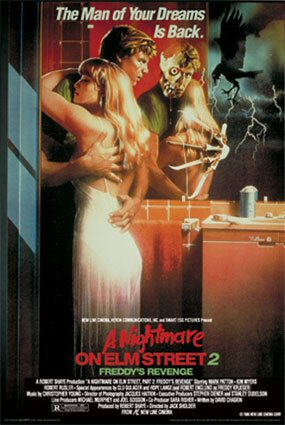
Trailer
to
Freddy's Revenge:

Deadly Friend
(1986,
dir. Wes Craven)
Based on the science fiction novel Friend by Diana Henstell, the screenplay was written by Bruce Joel Rubin, who
went on to write one of the worst films of all time, Ghost (1990), which we forgive him for since he followed it up with
that great mindfuck of a film, Jacob's
Ladder (1990 / trailer).
Trailer:

The film's best death scene:

Spoiler —
How
the movie ends:
Follow the link to Part III.


