

Bert I. Gordon
24 Sept 1922 – 8 Mar 2023
After 100 years, he's gone! Trashmaster Bert I. Gordon, "Mister B.I.G.", a seminal influence on the filmic taste of a wasted life, has entered the Film Palace in the Sky. He will be missed…
Born in Kenosha, Wisconsin, he was already making his own movies for fun by his teens. After a stint in the army during WW II, he married his first wife, Flora Gordon (1925–2016) — whom he divorced in 1979 — and started making TV commercials for a living. Soon after working as a production assistant on the TV series Racket Squad (1951-53), he produced his first genre film, Serpent Island (1954 — see Part I) and never looked back. He may have made "Bad Films" — he has the dubious honor of being the director/producer with the most films to have ever been on Mystery Science Theater 3000 — but many, though trash, are classics of their day and truly memorable. All get "better" with repeat viewings and age…
Go here for:
Bert I. Gordon, Part I (1954-58)
Bert I. Gordon, Part II (1960-70)
Necromancy
(1972, writ. & dir. Bert I. Gordon)


Trailer to
Necromancy:
We saw the 1983 re-release of Necromancy, a re-edited version that added a lot of nudity and was given the title The Witching a.k.a. Horror Attack, and we pretty much hated it — and now, nine years after we saw and reviewed it, we can't remember a damned thing about the movie, which tends to indicate it to be rather forgettable. The Witching's ending is different than that of the original Necromancy, but should you ever stumble upon the cut titled Rosemary's Disciples, you get The Witching with the original ending tacked on.

But: "Remember Orson Welles? He starred as Charles Foster Kane in one of the greatest movies of all time, Citizen Kane (1941 / trailer).* […] Later he starred alongside Rita Hayworth in The Lady from Shanghai (1947 / trailer),* a film about murder and mystery which was also well looked upon by most, though it would take a while. Welles would go on to star in many pictures over the years including another tale of corruption and murder alongside Charlton Heston and Janet Leigh called Touch of Evil (1958 / trailer).* […] The man, without a doubt was a genius in the film world, but even the best of men might stumble once or twice. […] Necromancy […] is not necessarily a stumble, but Welles is the best thing about the film […]. The question is why he ever agreed to appear in such a low budget production? Presumably he must have needed the work as the script by Bert I. Gordon […] was not the greatest to have ever come across his desk. Suffice it to say, he agreed to star in this film and the end result […] definitely could have ended up being a whole lot better if he had had a hand in any of the production, writing or direction though. [Telltale Mind]"
* We here at a wasted life heartily recommend all three films as must-sees, as well as his public-domain thriller The Stranger (1946 / trailer). The Magnificent Ambersons (1942 / trailer), on the other hand, is a total snooze…

Necromancy is "a different kind of Bert I. Gordon film, no big monsters, but you can't get much bigger than Orson Welles in stature and girth!! Just like The Amazing Colossal Man [see Part I], Orson Welles was bigger than reality! [Dwrayger Dungeon]"
During the shoot, the lead actress Pamela Franklin (of The Innocents [1961 / trailer], The Nanny (1965 / trailer) and Legend of Hell House [1973 / trailer] — all better films than Necromancy) and Harvey Jason (The Specialist [1975 / trailer] and Dr. Minx [1975 / trailer]) fell in love, and married. They are still together today.

Credit sequence as trailer:
Marc Fusion has the plot: "Lori (Pamela Franklin) has been on edge since she lost her child, an event that fractured her mind. She and her husband Frank (Michael Ontkean) soon head to the town of Lilith, where Frank has been offered a job with a high salary. He will work at a company that produces occult items, referred to by the locals as toys. On the way to Lilith, a car almost runs them off the road and in the wreckage, Lori finds a creepy doll with fingernail clippings in the pocket. But they continue on and soon enough, arrive in Lilith. Frank’s boss is Mr. Cato (Orson Welles), a charismatic man who seems to have a hold over the entire town. Mr. Cato also lost a child but he refuses to accept the death, only that his son is resting. Lori is suspicious from the start, but Frank shrugs her off, blaming her mood swings for her concerns. But when it becomes clear that Mr. Cato has dark intentions for the new residents, will it be too late for Lori?"

"Gordon goes for a dreamy, sinister vibe here that works much better in its original cut than the common The Witching version, which added lots of nonsense like a female ghost barking orders at our heroine. This would actually play pretty well with Halloween III: Season of the Witch (1982 / trailer) from both a plot and atmosphere perspective, and it's always fun to see Franklin strut her stuff in a horror film. Welles is clearly cashing a paycheck here, but he's never dull (to say the least). […] Overall it's a deliberately paced but interesting little occult shocker that works up to a respectably nightmarish level in the final ten minutes or so, and even the hokey twist ending is pulled off with more panache than usual. [Mondo Digital]


the re-cut version of Necromancy:
"[…] Featuring a campy plot that's almost entirely predicated on the heroine being an idiot, Necromancy tells the story of an evil Satan worshiper who wants to harness a young woman's occult powers in order to bring his deceased son back from the grave. […] Whether she escapes is of zero consequence, because the characters in Necromancy are as forgettable as the storyline. To its credit, Necromancy has quasi-atmospheric photography, a tasty electronic score that's akin to the sort of mood music later featured in John Carpenter's movies, and a couple of trippy dream/hallucination sequences. Yet these elements aren't nearly reason enough to watch the movie, especially since the slumming Welles gives an absurd performance complete with a ridiculous fake nose and an unidentifiable accent. The only magic this movie contains is the ability to put viewers to sleep. [Every 70s Movie]"

A face in the cast that might not immediately be recognizable is that of 5'3" Sue Bernard (11 Feb 1948 – 21 Jun 2019), above, who plays Nancy, the gal bonking Lori's duplicitous asshole hubby Frank, played by a distracted Michael Ontkean (of The Peace Killers [1971 / a trailer, with Lavelle Roby] & Girls on the Road [1972 / trailer, with the Great Uschi]). Sue Bernard was Playboy's Miss December of 1966, and her limited roster exploitation films includes fun stuff like The Witchmaker (1969 / trailer) and Curtis Harrington's The Killing Kind (1973 / trailer), but the best film of her entire oeuvre remains her debut film, Russ Meyer's classic roughie, Faster Pussycat, Kill! Kill! (1965, with the Great Haji and Tura Satana).

Trailer to
Faster Pussycat, Kill! Kill!:
The love theme to Necromancy, The Morning After, warbled in the film but never officially released, is sung by Mike Clifford, a singer who had previously appeared and sang in Bert I Gordon's 1965 film, Village of the Giants (see Part II). Still sort of active today, his biggest hit in the USA was in 1962 with Close to Cathy, possibly his best song, but he had already had his first taste of fame and success in 1961 at the age of 18 when his song Bombay was a hit in Venezuela. Clifford's The Morning After, in any event, should not be confused with 1972 Academy Award-winning theme song, The Morning After, from The Poseidon Adventure (1972 / trailer), sung in the film not by Maureen McGovern but Renee Armand.
Mike Clifford sings
The Morning After:
The Mad Bomber
(1973, prod., writ. & dir. Bert I Gordon)


Co-written with the expatriate American author Marc Behm (12 Jan 1925 – 12 Jul 2007), whose list of film projects includes The Return of Dr Mabuse (1961 / full film), Help! (1965 / trailer), and X-Ray (1981 / trailer, with Karen Smith). The Mad Bomber was Gordon's second R-rated film, after How to Succeed at Sex (1970, see Part II).
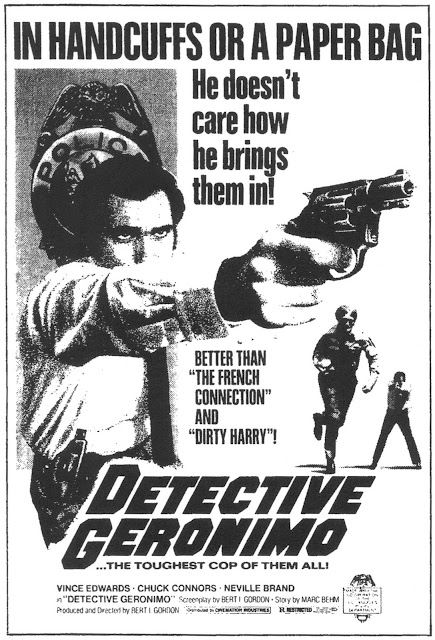
"Let me blanket the city with policewomen just asking to be raped! I'll bring him in!"
Lt. Minneli (Vince Edwards)

While never suggested in any texts we found online, a wasted life cannot help but wonder whether the film and its original title (it has many) were not inspired, at least obliquely, by George Peter Metesky (2 Nov 1903 – 23 May 1994), otherwise known as the Mad Bomber: over a period of 16 years in NYC, from the 1940 to 1956, he planted some 33 bombs in well-frequented places (injuring but never killing people) as revenge for being fired by Consolidated Edison after illness; he lost the subsequent work-comp court cases and had an axe to grind that he took out on NYC. A patriot, he stopped during WWII, explaining in a note (signed, like normal, as "F.P."): "I will make no more bomb units for the duration of the war – my patriotic feelings have made me decide this – later I will bring the Con Edison to justice – They will pay for their dastardly deeds ... F.P."

Trailer to
The Mad Bomber:
The plot, as found at Schmollywood Babylon, which forgets to even mention the third main character, the nominal "good guy" of the flick, hot-headed Lt. Minneli (Vince Edwards): "Chuck Connors ([10 Apr 1921 – 10 Nov 1992], below on a baseball card)* plays William Dorn, a super-conservative madman who, after his daughter's death in a drug overdose, goes completely bonkers and becomes the ultimate querulant. He hates how the kids of today have fun, he hates how women demand equal rights, he hates cops, he hates sex and... yeah, like a typical Republican (which is fitting, Connors himself was a registered Republican). Now he has a new hobby — to bomb the shit out of all the nice people! At the same time, a serial rapist, George Fromley (Neville Brand), stalks the city. They happen to be at the same place at the same time and Fromley sees the mad bomber (after first raping a nurse). When the cops realize this they understand that they need to catch the rapist first and make him identify the bomber! Let the thrills begin! […]"

* As with many an actor, there exists an ancient, grainy, B&W porn film purported to feature Chuck Connors, but who knows if it's the real man. In his case, it happens to be a gay porn loop (watch it here). Personally, we tend to think that if the ancient hand helper features any "Chuck Connors", it's the much shorter "Charles Connors" that posed for Bob Mizer's Athletic Model Guild long ago. Face it, a succesful baseball player moving into Hollyweird movies and TV wouldn't pose of Bob Mizer.

"The Mad Bomber [is] the director's foray into Dirty Harry (1971 / trailer) territory and the first film to exchange his trademark investigating female for a male […]. Here assassin William Dorn begins his violent campaign on the event of the death by overdose of his own beloved daughter, Anne. Having failed to protect her from the evils of society, he attacks the institutions he holds responsible for this failure. [Bright Lights]"

The Mad Bomber, in its original form, was a nice and sleazy exploitation flick as they were only made in the 70s. Currently, it exists in multiple cuts with multiple titles, and most have a lot of the sleaze and violence cut out. Going by what Ninja Dixon writes in his review of the film, the version titled The Police Connection retains all (or at least most) of the grindhouse attributes of Bert I. Gordon's original cut: "Yes, this version of The Mad Bomber is a helluva lot more powerful story than the earlier version I've seen. The atmosphere is grittier, dirtier and way more cynic. Chuck Connors (of Tourist Trap [1979], Soylent Green [1973] and so much more) makes a great performance as Dorn, and is physically very threatening with his tall body, wide shoulders and staring small eyes – behind a couple of corny glasses. Both him [sic] and Neville Brand (of Tobe Hooper's Eaten Alive [1976 / trailer], Kansas City Confidential [1952 / full film] and so much more) do wonderful jobs with their baddies, which can be rare in smaller exploitation movies. Up against them is Lieutenant Geronimo Minneli, played by Vince Edwards — an actor I don't have much memory off, but he also do a darn fine job as a tough cop."

Blood Brothers claims the flick is "an explosive good time" and "one of the most under-appreciated action/thriller films of the 1970s": "With a title like The Police Connection one would think this is a low grade clone of William Friedkin's 1971 crime thriller The French Connection (1971 / trailer). This however was a lame cash-in retitling by distributors and for me the film will always be known by its original title, The Mad Bomber, a fitting description of what the film is actually about – which is a fucking insane bomber going around and blowing shit up! […]"

Of course, as vintage exploitation films tend to be, The Mad Bomber a.k.a. The Police Connection has "an off-putting air of misogyny that runs throughout the film; aside from the rape scenes and the display of nudity by Fromley's middle-aged wife (Ilona Wilson [20 Jul 1933 – 5 Sept 2008], of True Identity [1991 / trailer] and Drum [1976 / trailer]) framed as additional evidence of Fromley's perversions, Dorn plants bombs at a women's liberation meeting (although it is later revealed that the target was the hotel not the specific meeting, but he does chose that particular ballroom to plant the bomb after sticking around to listen for a few minutes). Edwards' detective is rather one-dimensional, but it's fun to see Connors in a TV-unfriendly role […] and a sober Brand relishing a scuzzy role. […] The R-rated version lingers on the nudity of the rape victims, full-frontal strippers, and extended views of Mrs. Fromley, as well as a couple bomb-ravaged corpses (including the unconvincing-yet-still-shocking-just-for-being-shown aftermath of the bomber's comeuppance). [DVD Drive-in]"

And now for the peripheral stuff good to know for your next game of Trivial Pursuit. Martha, the deaf patient raped by George Fromley (Brand), is played by Faith Quabius: she married Chuck Connors in 1977, but in typical American style, they divorced a few years later on 15 April 1980. Nancy Honnold, who gets an "Introducing" credit in The Mad Bomber as Dorn's overdosing daughter Anne Dorn seems to have dropped off the face of the Earth after this film; she sang the movie's rather nice and folksy song, Reaching Out.

Reaching Out
sung by Nancy Honnold:
The adult movie theatre scene was shot at the Paris Theatre, at 8163 Santa Monica Blvd. in West Hollywood; it burnt down three years later in 1976. Millennials and Gen Zs, like Ninja Dixon, probably don't know who Vince Edwards [Zoino] (9 Jul 1928 – 11 Mar 1996) is, but in his day he was the gambling-addicted heart throb of many a Baby Boomer, who knew him as the doctor they hoped would take their temperature, Ben Casey, the titular character of the eponymous TV series that ran 153 episodes from 1961 to '66. (That's him below, prior to his 15 minutes of fame.)

The long career of Vince Edwards the actor included such fare as Cell 2455, Death Row (1955 /, with William Campbell), Kubrick's The Killing (1956 / trailer), Space Raiders (1983), Return to Horror High (1987) and The Fear (1995 / trailer), not to mention diverse interesting noirs during his early years. During his heyday years, Vince Edwards the crooner also released a number of LPs, all forgotten, which reveal him as a more than serviceable lounge singer…

Vince Edwards sings
I'll Walk Alone:
"Bert I. Gordon has never really been known as the most adept of directors when it comes to actors, but here it makes all the difference having three pros anchoring the story. An underrated talent often wasted in thankless TV roles, Edwards is great here in a slightly queasy role with his former heartthrob looks now turning seedy and sweaty; it's more than a little odd to see him hanging out to question employees at a strip club, surrounded by way more frontal exposure than you'd expect to see in a (relatively) mainstream 1973 film. [Mondo Digital]"

"This last shot is the best, and it cracks me up! It's shot from the ground up, and Vince Edwards looks as BIG as The Amazing Colossal Man! (see Part I). That Bert I. Gordon is one wacky cat! Lucky for all of us, we've still got more B.I.G. stuff yet to come, so stay tuned in!!! [Dwrayger Dungeon]"

The Food of the Gods
(1976, prod., writ, & dir. Bert I Gordon)


"My name is Morgan. I play football."

Nature-revenge films were a big thing in the 70s — see, for example, Frogs (1972 / trailer), Jaws (1975 / trailer), Squirm (1976 / trailer), Day of the Animals (1977), The Pack (1977 / trailer), Long Weekend (1978 / trailer; remade poorly in 2008 [trailer]), the original Piranha (1978), Alligator (1980) and so much more — and Food of the Gods fits in there with the best and worst of them, arguably a first cousin of the bottom of the barrel and indefinitely far more boring Night of the Lepus (1972 / trailer). Nevertheless, as Kindertraume points out, "this PG-rated late night favorite delivers more laughs than chills." That said, PETA will probably never give this flick a high rating, as one too many critter — mostly rats, but living things nevertheless — are crushed and shot and drowned and killed for real, something that our modern American sensibilities find harder to stomach than, dunno, the average school shooting. (After all, at most school shootings no animals are harmed.)

Trailer to
Food of the Gods:
The plot, from Badmovies.org: "A football player (Marjoe Gortner of Hellhole [1985 / trailer] and Mausoleum [1983 / trailer]) and his friends (Jon Cypher as Brian and Chuck Courtney [23 Jul 1930 – 18 Jan 2000] as Davis) take a trip to enjoy the great outdoors, but one guy (Davis [Courtney]) encounters a swarm of giant wasps that sting him to death. Some loopy backwoods man (John McLiam [24 Jan 1918 – 16 Apr 1994] of) and his likewise loopy wife (Ida Lupino [4 Feb 1918 – 3 Aug 1995]) discovered mysterious goo oozing out of the ground* and fed it to their chickens. Despite looking like pancake batter, the goo was not palatable until it was mixed with chicken feed. That did the trick, and the chicken coop was soon filled with birds the size of buffalos. Unfortunately, the farmer and his wife did not store the Food of the Gods in a canning jar, thus allowing the wasps to feed on it. Worse than the wasps are the rats (you would think that people living in a rustic cabin in the wilderness would be veterans at preventing rodents from raiding the larder). Soon, a small group of people, including a greedy investor (Ralph Meeker** [21 Nov 1920 – 5 Aug 1988] of Kiss Me Deadly [1955 / trailer], Without Warning [1980 / trailer] and The Mind Snatchers [1972 / trailer]) who wants to steal the goo, the investor's principled female assistant (Pamela Franklin), the football player, and a young couple (Tom Stovall and Belinda Balaski [of The Howling (1981 / trailer), Piranha (1978), and Till Death (1978 / full movie)]) anxiously expecting the birth of their first child, are holed up in the cabin and fending off a horde of ferocious giant rats."

* The idea of goo bubbling up out of the ground and not exactly being benevolent in what it causes was reused in 1985 by Larry Cohen (15 Jul 1936 – 23 Mar 2019) for his wonderfully fun satire of American consumerism, The Stuff (trailer).

** Go here to Poseidon's Underworld for everything you ever wanted to know about stud muffin Ralph Meeker, who regrettably never did a nude scene. Per the blog: "In 1976, [Meeker] hit what might be a career nadir when he took part in Bert I. Gordon's The Food of the Gods, loosely based upon an H.G. Wells story. In it, he became the food for some overgrown wasps, chickens and rats […]."

"There's an obvious attention to suspenseful violence over everything else, especially considering the narrative's design in regularly introducing additional roles, most of which essentially just provide fodder. People have a habit of spontaneously showing up on the island, solely to succumb to gigantic creatures. Fortunately, many of these sequences are effective — in a cheesy, low-budget, dated sort of way — through the utilization of live-action animal footage rapidly cut with animation, miniatures, puppets (and gooey, rubbery props), and plenty of gore effects. It's not always convincing, but it has a certain charm to it — as long as viewers can keep their expectations to Z-grade '70s exploitation mode. [Gone with the Twins]"

"'I'll bet those rats can't swim,' Marjoe speculates. 'When you're a rat and suddenly you weigh 150 pounds, you got to learn all over again how to swim.' He dashes to his Jeep, races over to the dam, blows it up with two well-placed charges and drives so quickly that he gets back to the house before (a) the floodwaters, and (b) before we ask ourselves what a dam could be holding back on a small island with no apparent heights. [Roger Ebert]"

"The Food of the Gods was laughed at for its awfulness when it was originally released and it has gained a small cult following over the years due to this fact. For a silly B-movie it can be fun, even if it does take a shit on a classic H.G. Wells story. [Blood Brothers]"

Final Girl loved it, but it turned out to be an amour fou: "I know it seems extra-fast to be talking marriage when I'd only known Food for about 25 minutes, but come on! It was totally sweet and it understood me like no one's ever understood me before. We really connected, you know? Like when there was another wasp attack, only this time it featured the worst special effects I've ever seen in any movie in the history of ever! […] I was so happy I wanted to get a cellophane wasp tattooed on my face — that's how in love I was. And I meant it! But then... I don't know, diary. Something changed. Food of the Gods was all 'It's time for the humans to fight back!' […] But what happened was, rats started getting hurt... Like, real rats, getting... I don't know, shot and drowned and stuff and it was REALLY UPSETTING. […] I swear, it was like Food of the Gods had turned into Ted Bundy or something! Like, how can someone so charming and attractive turn out to be so eeeevil? I felt duped, and I was like, "I don't even know who you are anymore, FotG," and I mean I really said that. […] So I said, maybe we shouldn't live together anymore, and then Food was like "Wait wait wait, what about this?" and then Ida Lupino [below from her Golden Years] had a fight to the death with a giant fake rat and they die together […]. I swear, I almost caved in! But I held strong and I said no! You can't just do one little (admittedly awesome) thing and expect me to forget all the bad things you did … I think you should go now. […] I felt great about it, even though I felt bad about it because I really wanted things to work between me and Food of the Gods and I'm trying not to be depressed about it because I really felt like we were a perfect match — and most of the time, we were. If FotG hadn't turned out to be a homicidal maniac, I'd totally be getting that cellophane wasp tattoo right this second. But alas, alack, it is not to be. […]"

Supposedly, Ida Lupino's character wasn't even intended to die, she just wanted to get back to Los Angeles and asked to be killed off [Horror 101]. Food of the Gods ended up being her second to last feature film; three years later, in 1979, she and Ralph Meeker, her husband in FotG, were once again cast as a couple in Bethel Buckalew's final directorial hicksploitation flick, the tepid My Boys Are Good Boys (1979), the director's first film that wasn't focused on breasts and sex.

Dorsey Burnette sings the theme song to
My Boys Are Good Boys:
Food of the Gods was A.I.P.'s biggest financial hit that year. It also ended up being the last feature film role Pamela Franklyn was ever to make. Initially, she moved into TV roles, but she hasn't acted on the big or small screen since 1981. Jon "Brian" Cypher went on to appear in Tobe Hooper's Spontaneous Combustion (1989 / trailer), but Chuck "Davis" Courtney has the real anti-classic to his name: he's the titular hero of Billy the Kid vs. Dracula (1966 / trailer)!

The end credits of Food of the Gods infer a possible sequel by playing over the image of a child drinking milk that is likely carrying the growth substance. If Bert I. Gordon was planning a sequel, he never saw it through. Instead, it took some 13 years before Canada regurgitated a "sequel in name only", Gnaw — Food of the Gods II, which is supposedly as funny and tacky as Gordon's film.

Trailer to
Gnaw — Food of the Gods II (1989):
Empire of the Ants
(1977, prod., writ. & dir. Bert I. Gordon)

"Oh my God! They're herding us like cattle!"
Coreen Bradford (Pamela Susan Shoop)

A year after Food of the Gods, Bert I. Gordon returned yet again to his Mr. B.I.G. roots, radioactivity, and the works of H.G. Wells (21 Sept 1866 – 13 Aug 1946) and made this popular disasterpiece. This time around, Gordon's eighth film to deal with big critters, the filmmaker turned to a 1905 short story (read here) by Wells, Empire of the Ants, and substantially tweaked it to fit the tale he wanted to tell. Thus, instead of early 19th-century South America, we have 1970s Florida, and the intelligent ants are now colossal in size instead of simply a few centimeters large. An A.I.P. film, it was the second of three H.G. Wells adaptations that the company released in the seventies, preceded as it was by Gordon's own Food of the Gods (1976) and itself preceding Don Taylor's The Island of Dr. Moreau (1977 / trailer).
"You're so terrific in the sack, it almost justifies the excessive salary I have to pay you."
Marilyn Fryser (Joan Collins)

Empire of the Ants:
The plot, from Generation X Movies: "Witness a ship dumping drums of radioactive waste into the ocean. Witness the drums washing ashore on a remote island. See a colony of ants get caught up in radioactive waste as it oozes out of a drum. You know where this is going, don't you? Almost overnight, you have an island full of giant ants. […] This movie features a bitchy and domineering real estate develop (Joan Collins of Don Sharp's Dark Places [1974 / trailer]) taking a group of prospects to a nightmare island. The group consists of stereotypical messed-up misfits […]. At the helm of the ship is a crusty captain (Robert Lansing*) who is trying to maintain some dignity while being pushed around by the developer. They mingle and divulge some of their innermost secrets for the first third of the movie and then the ants arrive, taking down a couple of the prospects. This is when the fun begins and it's man verses monster in a game of survival."
* Robert Lansing [5 Jun 1928 – 23 Oct 1994], familiar to many a Baby Boomer and Gen Xer as the man with a cat from the Star Trek (1966-69) episode Assignment: Earth (broadcast 29 March 1968), also appeared in some other "good" stuff after his feature-film debut in the genre flick 4D Man [1959 / trailer]), including Scalpel a.k.a. False Face (1977 / trailer), The Nest (1987 / trailer), and the obviously Guy N. Smith-inspired big-killer-crabs-in-Florida flick, Island Claws (1980 / full film).

"All we wanted was to enjoy what was left of our life. Is that bad?"
Velma Thompson (Irene Tedrow)

To give the nine future ant victims and ant survivors that Marilyn brings to the island names and stereotypical, soap opera personalities, there are: Coreen Bradford (Pamela Susan Shoop of The One Man Jury [1978 / full film]), a young woman recovering from a relationship with a married man; Margaret Ellis (Jacqueline Scott [25 Jun 1931 – 23 Jul 2020 of Sugar Boxx [2009 / trailer] and Macabre [1958 / trailer]), an executive secretary; a young married couple, Larry (Robert Pine of No Man's Land: The Rise of the Reeker [2008 / trailer] & Wes Craven's Red Eye [2005]) and Christine Graham (Brooke Palance of The Clairvoyant [1982 / trailer]); a middle-aged couple, Thomas (Jack Kosslyn [28 Dec 1920 – 24 Jun 2005]) and Mary Lawson (Ilse Earl [4 May 1931 – 7 Mar 2006]); an older couple, Harry (Harry Holcombe [11 Nov 1906 – 15 Sept 1987] of Foxy Brown [1974 / trailer] and Psychic Killer [1975 / trailer]) and Velma Thompson (Irene Tedrow [3 Aug 1907 – 10 Mar 1995] of Mandingo [1975 / trailer]); and a brooding young man, Joe Morrison (John David Carson [6 Mar 1952 – 27 Oct 2009] of Pretty Maids All in a Row [1971 / trailer] and Creature from Black Lake [1976 / trailer]). That's John David Carson looking manly below, who know from where…

"This turned out to be one hell of a free vacation."
Joe Morrison (John David Carson)

Featuring a temporal reality of reproduction that can only exist in film, all the events of Empire of the Ants seem to transpire over a period of a few days. But then, that is probably the least thing about the film that will lead you to laughing or scratching your head. Empire of the Ants appears to be the only feature-film script ever credited to scribe Jack Turley (21 Jul 1927 – 19 Jan 2021), who specialized in TV series and soap operas, though he did do a rare TV movie script like that to the derivative Terror on the 40th Floor (1974 / trailer) or the oddly popular Pray for the Wildcats (1974 / "trailer").

"Filmed in Florida and released on July 29th 1977 […], Empire of the Ants, while not the greatest giant bug movie in cinema history, deserves a little bit more respect than it gets. First of all, its story by Gordon and Jack Turley is well written enough for the audience to suspend disbelief. Second, the veteran cast in this film is top notch and they take their roles seriously thereby convincing us that the threat is real. Also, Bert I. Gordon's direction is more than competent and even the ant sound effects are pretty effective. The reason this movie gets ridiculed is due to the ants themselves. […] The rear projection/enlarged photography used when the ants interact with humans never seems to work convincingly. The few shots of the ants alone work well enough and the puppet ants used for close-ups are somewhat effective due to the fact that they are never dwelt upon so as not to see their flaws, but any trick shot involving an ant and a human together unfortunately becomes laughable because the images never seem to match up […]. The good news, […] is that the rest of the film works and is quite fun. […] Ok, so the ants don't look that great, but the cheesy effects just make the movie even more fun in a 'so bad, it's good' way. […] [Cinema Retro]"

Normal trailer to
Empire of the Ants:
Over at Media Mikes, Mr. B.I.G. told Mike: "We shot the film in Florida in an area that was very much like Africa. We had a boat on the river and the film called for Joan Collins to fall into the water where there were real alligators. They were all around and we had to have the grips hold them back. I know Joan made a comment in one of her books that it was the roughest picture she had ever worked on. The ants I shot down in Panama. A lot of the so called critics complained that I used stock footage of the ants but I never used stock footage at all. I went into the jungle with an entomologist from UCLA and we filmed the preface for the film in the jungles of Panama. For the ants that were in the story I had the entomologist collect a lot of them. The ones I wanted to use were poisonous but they had fuller bodies. He collected them and in my hotel room I had a blue backing and lights and we shot the miniature stuff with the ants. We shot all the ant stuff down there… didn't want to bring them back!"
Thank you, Mr. B.I.G., for not importing a possible invasive species — and for making such a wonderfully tacky, craptastic film as Empire of the Ants!
"I'm not running a charity organization."
Marilyn Fryser (Joan Collins)

"Frankly, this has to be one of Gordon's best films. Not only are the ant effects better than anything in his previous giant bug movies, but he finds enough plot turns and twists for two of his fifties movies. As always, it's good to see Robert Lansing […], although he is nearly hidden behind a scruffy beard. As this is a Bert I. Gordon film, the rest of the cast […] seem to have been drawn from television. Which, again, is no surprise. […] But it is that bold, final twist which really stands out. One might note that it bears a slight resemblance to an idea which shows up in Phase IV (1974 / trailer) but never really gets fully developed. It is a deeply disturbing, to put it mildly […]. And it is one of those endings which would never have been made except in the seventies. […] It's just a touch smarter than your average B-Monster movie but it still generates its share of scary moments. And that means it is well worthy of a midnight viewing. [Rivets on the Poster]"
"I farted... ants."
Harry Thompson (Harry Holcombe)

At All Movie, Donald Guarisco would agree: "The script refines the formula of Food of the Gods, pitting a gaggle of diverse soap-opera stereotype characters against a menace straight out of 1950's nuclear-fear monster mash […]. The dialogue is corny, the plotting is daft and the special effects are as antiquated as they are unconvincing. That said, Empire of the Ants is actually quite entertaining for those in the right trash-craving frame of mind. Gordon's tidy direction keeps things rolling at a fast clip and his script's silliness is informed by a sense of humor about its contrivances that gives it some camp appeal. The sense of humor continues to the cast: Joan Collins hams it up in a way that suggest she is preparing for her later role on Dynasty (1981-89) and Robert Lansing informs his heroic role with a sarcastic, deadpan sensibility that makes him fun to watch. The film's third act also boasts a surprise twist that is so hilarious that it makes the film worth watching for b-movie fanatics all on its own. In short, Empire of the Ants is low-rent schlock but that's okay because it's well aware of what it is and simply sets out to entertain those who are predisposed towards this sort of fun. Trash aficionados who like their monsters big and their plots goofy are sure to enjoy it."

Empire of the Ants only reached the UK in 1979, when it was released as the bottom half of a double feature with The Brinks Job (1978 / trailer below).

The Brinks Job:
Burned at the Stake
(1982, prod., dir. & writ. Bert I Gordon)

A.k.a. The Coming. Five years after Empire of the Ants, Bert I. Gordon returns to supernatural horror and made Burned at the Stake, one of his most obscure productions for Alan Landsburg Productions, the firm that brought you such fine stuff as Ants (1977) and Tarantulas: The Deadly Cargo (1977) and other cultural highpoints of filmic history. At the moment, the full film can be found here at the Internet Archives.

"Its theatrical release scattered and limited, The Coming attained its biggest audience when it premiered in an 80-minute time slot as a CBS Late Night Movie in 1988. [All Movie]"

Spanish trailer to
Burned at the Stake:
We here at a wasted life actually saw this film once upon a time, in our pre-peach fuzz years, a fact we only realized when looking at the photos at Kindertauma and remembered the Rottweiler. Kindertrauma says "OK, this movie is patently ridiculous but it's way better than I ever dared hope. Plus, it's all autumnal and takes place in beautiful Salem, Massachusetts! Fortuitously, I found it mere hours after having seen Rob Zombie's Lords of Salem (2013 / trailer), and I decree that the two movies make an excellent wonder twin double feature! I think they might have even used the same graveyard! It's probable! Kooky though it may be, Burned has a semi-cruel dark streak as only a film that concerns itself with a five-year-old being burned alive can. Susan Swift's performance is seriously solid, regardless of the heaps of hokum thrown at her and frankly, I'd take this cockeyed lunacy over drippy Audrey Rose (1977 / trailer) any day of the week!"

The full plot of a film with spoilers: "During the Salem witch trials in 1692, spoiled brat Ann Putnam (Susan Swift of Harper Valley PTA [1978 / trailer]) falsely accuses the wife and young daughter of William Goode (David Rounds [9 Oct 1930 – 9 Dec 1983]) of being witches. Her accusations, given in concert with corrupt witchfinder Reverend Parris (John Peters [died 23 Oct 2005]), results in William's wife being hanged and daughter Dorcas (Jennine Babo of Death from Beyond 2 [2008 / trailer]) about to be burned at the stake. Cut to the present day, where Loreen (Swift again) and her classmates are taking a class trip on the history of the Salem witch trials. On their way to the Salem Witchcraft Museum, Loreen feels a strange sensation when the bus she is in passes local witch Merlina (Beverly Ross of 3 Women [1977 / trailer]) walking down the street and her dog starts chasing the bus, running alongside Loreen's window and staring at her. Once at the museum, William Goode is magically transported to the present day and attacks Loreen, thinking she is Ann Putnam. William runs away and his eyes can't believe what he sees (automobiles and planes), but he still manages to avoid the police and stay within spying distance of Loreen, even though local cop Captain Billingham (Albert Salmi*) is called in to investigate Loreen's attack (he thinks William is a sexual predator). The class trip still goes on and when they visit the Salem cemetery, Loreen's teacher is killed when she saves Loreen from a falling tree branch. After her teacher's death, Loreen begins to talk in an early American dialect and her worried mother, Karen (Trisha Sterling of The Name of the Game Is Kill [1968 / trailer]), calls on famous psychologist Dr. Grossinger (Guy Stockwell [16 Nov 1933 – 6 Feb 2002] of The Beat Generation [1959 / Louis Armstrong], It's Alive [1974 / trailer], Grotesque [1987 / trailer] and Santa Sangre [1989 / trailer below] — all better films than this one) to look at her but, at first, he has no idea what is going on. When William breaks into Loreen's bedroom and confronts her, Karen shoots him (nothing happens; the bullets just pass through his body) and Captain Billingham captures him and puts William in the local jail, where he tells his story to an understanding TV reporter (Frank Dolan). We then begin to realize that William was sent to the present day to get Loreen, who is now possessed by the spirit of Ann Putnam, to confess to her lies about her accusations against Dorcas. If she does, William's daughter will be saved from being burned at the stake back in 1692. When the reporter is killed (by the horribly burned visage of Reverend Parrish and the possessed Loreen) for getting too close to the truth, good witch Merlina helps William, Kathy and Loreen achieve karmic justice. […] [Critical Condition]"

* Albert Salmi (11 Mar 1927 – 22 Apr 1990) was a successful character actor who started his career by turning down an Oscar nomination for The Brothers Karamazov (1958 / trailer), moving on to do turns in such films as the gory Superstition (1982 / trailer) — which shares the witch-returning plot point of Burned at the Stake — Dragonslayer (1981 / trailer), Moonshine County Express (1977 / trailer), The Take (1974 / full flick) and Don Taylor's Escape from Planet of the Apes (1971 / trailer). He retired from acting in 1989, and the following year, on 6 February, his wife of 26 years, Roberta Pollock, sued for divorce, complete with a restraining order, accusing him of being an abusive alcoholic who had threatened her life several times. Albert Salmi response was that of a normal, white male putting his uppity wife in place: going to their former shared home in Spokane, WA, he shot her dead in the kitchen, where she belonged, and then shot himself in the bedroom, which she should have continued sharing with him. (Vote Republican in 2024!)

Santa Sangre (1989):
"Gordon [...] left behind a puzzle in this movie. I've seen most of Gordon's oeuvre, and usually there's some rationale for the movie's main problem, whether it's a man mutated into a giant or a psychopath trying to remember the trauma that warped his personality. Stake, though, is probably Gordon's most incoherent movie. That makes it a real challenge to figure out what he was trying to get across with his story of a 'witch-finder' girl of America's Puritan days whose spirit possesses the body of her modern-day reincarnation. [Naturalistic! Uncanny! Marvelous!]"

"For the first ten minutes of the movie, I thought this was going to be another of those dramas about the Salem witch trials; it's quite bad during this sequence (at least partially because of the very clumsy period dialogue being used), and I was glad when the movie took a left turn into the present. Still, that left turn is pretty bizarre, and the story (which is kind of a cross between The Exorcist [1973 / trailer] and a reverse-angle version of one of those 'witches returning from the dead' stories) really doesn't make a whole lot of sense. For some reason, the possession of the girl gives her witch-like powers (despite the fact that Ann Putnam was not a witch but merely accused others of witchcraft), and in order to save her the powers of a real witch are needed. […] Still, for a movie that is often quite bad, it has its moments […]. Susan Swift (as both Ann Putnam and the girl she possesses) gives a good performance, but I did get very annoyed with her constant yelling and crying, a problem I'm more likely to attribute to bad direction than to her talent. It's a strange entry into the oeuvre of Bert I. Gordon, and though it has some interesting ideas, it never comes together. [Fantastic Musings & Ramblings]"

Susan Swift retired from acting after Halloween: The Curse of Michael Myers [1995 / trailer] and subsequently became possessed by a real demonic force and is now does her part to bring hell to earth by being a successful housewife, mom, lawyer and Republican.

Let's Do It!
(1982, pro., writ. & dir. Bert I. Gordon)

"Does he have a genuine sexual hang-up or is he just a fool?"

Twelve years after How to Succeed with Sex (1970 — see Part II), Bert I. Gordon returned to the sex comedy genre. And once again he proved himself to be, like most cis-gender males, a breast fetishist. An extremely love-pillow heavy flick, this 3-D film really should have been titled, Nice Tits! Johnny LaRue says it like a man, overlooking the actually McMuffin that drives the plot: "Boob fans need to see Let's Do It! [It's] about a guy named Freddy (Greg Bradford) who attracts a lot of women. Director Bert I. Gordon's idea of filmmaking is to point the camera at his starlets' chests, not that I'm complaining (much)."

Trailer to
Let's Do It!:
Although Let's Do It! is — besides being breast-heavy and totally PI in a way only a teenage sex comedy from the '80s can be — a breast fetishist's dream visually, its plot hangs on an extremely obtuse, breast-phobic concept, as the perusable and gay website Favorite Hunks succinctly explains: "The movie's premise is flimsy […] with Freddie (Greg Bradford) dealing with a heavy dose of sexual anxiety brought on by a few too man years of suckling on his mothers breasts." ("Man years"? Freddie couldn't have been older than 5 or 6 or 7…)

Illegal use of footage of King Kong (1933 / trailer) has resulted in this obscure "teen sex comedy" becoming virtually unattainable; the few rips or ripped scenes found online are of a quality that is virtually unwatchable — not that film is really all that watchable in a typical sense. (Here's an upload at this decidedly NSFW! website.) Ancient VHS versions can be found on online auction sites, but usually at prohibitive prices… especially considering the film itself.
"When the pressure is on to 'get it on', a hard man is good to find."

So few people have seen this movie that online reviews are rare, but Teenage Frankenstein saw the "simply astonishing" movie so you don't have to: "Bert I. Gordon […] brings us this spectacularly unfunny sex comedy. However, this is another bottom-feeder sex farce of the time, so aggressive in its attempt to milk laughs, that it has a degree of watchability due to the audience's disbelief. Freddie (Greg Bradford), who was breastfed way past an appropriate age, is a college student struggling with sexual impotency. His girlfriend of one year (Britt Helfer) demands that he makes love to her if they want their relationship to continue. Desperately searching for a cure, Freddie attempts to make love to various women, including one of his professors and a bevy of hookers. […] There's a sequence where the hookers sit at a table and discuss their sexual hang-ups and issues. Both Freddie and his girlfriend have surreal dream sequences, including one with footage from the original King Kong […]. The women are often quite attractive (including a young Betsy Russell), but even their constant disrobing becomes monotonous. […]."

Scene from
Let's Do It!:
Over at imdb, jadavix was also not amused: "[…] The footage from that particular classic [King Kong] is, of course, completely wasted and serves no purpose to the movie whatsoever, like every other aspect of it except for the naked female flesh. In plot and set up it is actually also more like the British sex comedies of the '70s than Porky's (1981 / trailer) or Animal House (1978 / trailer). If it is intended as a comedy, as usual for this type of thing, there are no jokes, or situations exploited for comic potential. If it's intended as softcore, there is no eroticism, though there is plenty of nudity. Watch for the scene where the dim-witted hero sits down with a table of sex workers who tell about their sexual problems. One talks about being made to do child pornography since the age of seven. Yes, this is a 'comedy'. […] The hero's wide eyed innocence also began to grate on me. He's not charismatic enough for a comedy […], and he looks awkward in the sex scenes, which is perhaps why there are so few."

The lead man "not charismatic enough for a comedy", Greg Bradford, had his first credited role two years earlier in Skatetown USA (1979 / trailer) [above] but washed out of acting by Vendetta (1986 / trailer). That's him a bit further below, hiding his goods, from his days thereafter, during his stint as a Chippendale's dancer.


Rolf Hansen / Gregory Bradford
Miami Vice demo:
In any event, Bert I. Gordon "gave us giant ants in Empire of the Ants (1977), giant rats in The Food of the Gods (1976), and giant boobies in Village of the Giants (1965). Now in Let's Do It! (1982), director Bert I. Gordon presents a mommy complex so gigantic that it keeps virginal Greg Bradford from nailing babelicious Britt Helfer. This sex comedy is crammed full of hot babes who make the idea of chastity laughable — including Tami Floberg as a hottie hooker, Betsy Russell in her screen debut, and Brinke Stevens and Monique Garbrielle in early, uncredited roles. Still, it's left to Britt to bare breasts, brush, and brut . . . er, butt in two towering full-frontal scenes. [Mr Skin]"

Not in the movie, but released the same year:
Kadenza — Let's Do It
It seems that the "hot hooker" Tami Floberg never made another movie. Britt Helfer's oeuvre includes Raw Force (1982 / trailer), Young Warriors (1983 / trailer) and Alley Cat (1984 / trailer), but she gave up her nominal film career when she married and had kids. Betsy Russell, who seems to have graduated the same year from the same high school as a wasted life, where we never noticed her, made her film debut in this movie. Her films of note include Avenging Angel (1985 / trailer, with Susan Tyrrell), Cheerleader Camp (1988 / trailer) and Camp Fear (1991 / trailer).
Schlockmeisters Movie Reviews
#918 — Let's Do It!:
The Big Bet
(1987, prod., writ, & dir. Bert I. Gordon)

Let's Do It! was such a big hit (NOT!) that Gordon obviously decided to do another teen T&A comedy. It only took him a further five years to get around to it, and the film he made, The Big Bet, is now more or less just as obscure as the film that preceded it. Most of what happens in the movie wouldn't fly today and, as typical, for all the enjoyable nudity delivered by the six different females, including full frontal nudity, no male in the movie measured up to letting anything hang out or to also doing a full frontal. (Penis — the bane of civilization.)

Trailer to
The Big Bet:
Obviously enough from the trailer, not a movie one needs to see. But one or two people have… like the unknown, English-language-challenged person who offers this synopsis as WIP Films: "Chris Collins (Lance Sloane) is a teen whom resides in a state of irreversible sexual stimulation. He seems to exist rich and varied sex lifetime involving simply about every woman he fulfils but, unfortunately for Chris, these experiences exist just in his too-hot mind. At school Chris is smitten by a new girl on campus, the beautiful blonde, Beth Lowell (Kim Evenson). His obsession with Beth does not go un-noticed by the school bully who manoeuvres him into betting his car that he can't get into bed with Beth in Norman (Ron Thomas), one week. Chris is desperate and appeals to a newly-arrived neighbour, the worldly sophisticated Michelle (Sylvia Kristel) for advice and gets more than he ever hoped for."

From the film — David Pomeranz sings
What Does A Man Have to Do:
Psychotronic Review, which says the film "has the advantage of most of the sex being in the main (virgin) character's mind" and "is tedious to watch now but perfect for the market at that time" points out the reason why, were the film set in today's world, the main male character would do what all men do today and simply use date-rape drug: the "new girl at school […] turns out to be a reverend's daughter." By the end of the movie, however, Chris is singing "The only gal who could ever reach me, was the daughter of a preacher man" and, like good high school students, they keep the baby because they didn't resort to any sinful birth control.

From the film — Mental Notes sings
It's Real To Me:
Over at All Movie, Eleanor Mannikka is not impressed: "An adolescent softcore story with a plot that is hardly credible […]. Once that premise is established, sexual encounters and low-level erotica follows with an understanding female (Sylvia Kristel [28 Sep 1952 – 18 Oct 2012] of Red Heat [1985 / trailer] & Dracula's Widow [1988 / trailer]). Character development is not of the essence here, and neither is the troubled, insecure woman who is the target of the bet."

"[…] If you hadn't guessed, we were in that venerable genre the eighties teen sex comedy again, but this one was interesting for the man behind the camera, none other than Mr B.I.G. himself, Bert I. Gordon. […] By this stage he had branched out into skinflicks. Nothing hardcore, and to be honest nothing really that distinguishable from countless others of its day, but Gordon's low budget sensibilities were served well by this style, where the only 'special effect' necessary was a naked woman or ten to keep the audience interested. […] But what of that bet the title references? […] The fact that our protagonist takes this bet doesn't speak too well of him, indeed it makes him difficult to sympathise with when he's acting pretty reprehensibly, not least because the "You went out with me for a bet? You bastard!" plot was looking ancient by this point. Then there's the way he becomes slightly obsessed with Michelle to the extent that not only does he spy on her undressing, but even enters her house and takes a peek at her in the shower — and we're supposed to like this guy? […] If you could overlook the sleaziness of Chris, then The Big Bet was much as you'd expect, and painless for that. [Graeme Clark @ Spinning Image]"

Used in the film —
Rob Tro's Let Me Be the Knight:
None of the music of The Big Bet is of quality, as the three songs presented here solidly evidence, but only Rob Tro, the singer of the extremely generic AOR song above, seems to have been a "real" musician attempting at a carrier outside of a studio musician for hire. He failed in his attempt and little is known about him today, but the blogspot Hard Rock/AOR Heaven, which inexplicably likes his drivel and rates the "mega rare" LP as "highly recommended", did do some research: "[…] There's always an unknown little gem hidden under the carpet. Rob Tro seems to come out of nowhere, there's no info about his origins or career. I've been looking deeply in the net, specialized magazines from my own collection, and asked some friends (real AOR collectors). Zero results. Well, the important thing is the music, and Rob Tro's Intro is full a goodness. Tro (curious last name) is on the wagon of the soloists from the first half of the eighties: a good vocalist backed up by expertise musicians. No one of them are credited on the artwork, but all are more than competent sessionists. The aural and cheesy (but beautiful) Let Me Be the Knight reminds me John O'Banion circa his Dangerous album. This is the kind of American AOR I love. Rob's vocals are sweet and velvety, with nice color. […]" You agree?

Lance Sloan, who plays the main character, made the right decision and retired from acting after this film; he now produces an occasional TV series or film. Ron Thomas, who plays Norman, the "bully" of the film, is of course "well known" from the Kobra Kai films and TV series; we prefer him in the unknown of competent slasher, Night Screams (1987 / trailer). As for the "buxom, gorgeous, and voluptuous blonde bombshell" Kim Evenson, who plays the reverend's daughter Beth, she was Playboy's Playmate of the Month for September 1984 (centerfold above) and made a short string of movies in the 80s, beginning with Porky's Revenge (1985 / trailer), in which she bared her two biggest talents a lot. Her next, Kidnapped (1987), with Barbara Crampton and Charles Napier, is terrible but fun, sleazy exploitation trash, much like the truly trashy "drama" Kandyland (1998 / trailer). Her last project before she fell of the face of the Earth, Joe Ritter's The New Gladiators (1984), is, as far as we can tell, nothing more than a re-edited and partially reshot stateside version of Lucio Fulci's substandard I guerrieri dell'anno 2072 a.k.a. The New Gladiators (1984 / trailer).

Satan's Princess
(1989, prod. & dir. Bert I. Gordon)

Two years later, Bert I. Gordon returns with a new film, dumping the teen sex comedy genre for the demonic T&A horror genre. We would actually like to see this slab of substandard trash one day, in part because we "looked" at the film some three years ago when we reviewed the career of the Babe of Yesterday Marylin Joi (Part V: 1981-2019). Ms. Joi has a tiny role as a hooker in the film, so we cobbled the following:

From the movie's soundtrack —
Terry Wood sings This Nite:
(Lotsa ta-tas in this one.) A.k.a. Heat from Another Sun, Princess of Darkness and Malediction. Even exploitation babes eventually experience the fate of female actors in the biz: you hit a 'certain age', and you become invisible. Maybe Marilyn Joi had other reasons for disappearing from the screen, but after C.O.D. (1981) it was eight years before the now 44-year-old Marilyn Joi was seen again in a feature-length product… in a blink-and-you-miss-it bit as a hooker in this direct-to-VHS flick. (Ain't no such thing as a white hooker, you know.)

One sort of wonders why it took an auteur hack like Gordon — who can forget his anti-classics like The Amazing Colossal Man (1957 — see Part I]), Attack of the Puppet People (1958 — see Part I]), The Spider (1958 — see Part I]), Village of the Giants (1965 — see Part II]), Necromancy (1972), and the double attack of Food of the Gods (1976) and Empire of the Ants (1977)? — such a long time to get around using Marilyn Joi in one of his films… Oh, yeah: 'cause few of them ever feature an Afro-American character. […]

Screenplay scribe Stephen Katz (4 July 1946 — 18 Oct 2005) began his career with the far more intriguing an offbeat script to the hard-to-place Hex aka The Shrieking (1973 / full film). Satan's Princess was both his second and second-to-last feature-length film project.

The plot, as found at the Science Fiction, Horror and Fantasy Film Review: "Retired police detective Lou Cherney (Robert Forster [13 Jul 1941 – 11 Oct 2019] of Alligator [1980] and Uncle Sam [1996]) is pressed by a man to search for his missing daughter. Lou finds that the missing girl has been taken as the lesbian lover of Canadian modelling agency head Nicole St James (Lydie Denier of To The Limit [1995]). As he starts investigating Nicole, Lou learns that she is involved with black magic. People who provide Lou with information turn up dead and then Nicole marshals occult forces in an effort to kill him."

"Bert I. Gordon on his best day was no better than an average director, but his enthusiasm and lack of taste were generally good for an entertaining movie. Satan's Princess […] is a well-paced and very silly combination of urban crime drama and supernatural chiller. And it features Borscht Belt comic Jack Carter (of The Happy Hooker Goes to Washington [1977, see Joi Part IV]) as a 15th-century Spanish priest. […] One thing you gotta respect about Robert Forster is that you can never catch him sleepwalking through anything. Not only does he always seem to give each project 100%, regardless of how big a turkey it is, he usually is able to jack the movie up a notch or two with his performance. Satan's Princess is dumb and laughable, but I'll be damned if Forster doesn't fill in the gaps in Gordon's screenplay and create a full-fledged character that's a joy to watch. [Johnny LaRue's Crane Shot]"

Spoilers: "There's plenty of sleaze and exploitation to the proceedings. You get a lesbian sex scene, a topless woman swallowing fire, a Robert Forster sex scene where he talks dirty and spanks, and a poor bimbo gets her tit cut off. The film is pretty consistent until the last 30 minutes when it goes over the top and spreads the cheese on thick. […] The gore is minimal and the deaths range from realistic slasher murders to the supernatural. A cop gets strangled, a woman gets blown out of her apartment window, and Satan's Princess gets torched with a flamethrower. The film's finale is pretty anti-climatic and ends with a demon trying to escape in a booby-trapped car… [80s' Horror Central]"

We couldn't find a trailer for Satan's Princess online, but we did find a fan-made homage using Samantha "I Got Boobs" Fox's song Touch Me (I Want Your Body), a song typical of its time (1986) that gets virtually no airplay nowadays.

Satan's Princess Tribute:
To the above, Psychotronic Review might add: "Here's another film in the mold of The Mad Bomber (1973). But this time, it features a very engaging hero and villain. The problem is that despite a fine performance by Robert Forster, the ex-cop character suffers from the 'cop who doesn't play by the rules' trope. It needs care and you really can't justify torturing a Peeping Tom. That's when the character goes from antihero to asshole. The film is a mash-up of the Satanic thriller and determined cop genres. Forster plays the drunk ex-cop with a limp who is trying to find a runaway (Leslie Scarborough of Demon of Paradise [1987 / trailer] and The Naked Cage [1985 / trailer]) who is being kept by a demon in the form of a supermodel. The ending features a lot of fire."

"It's of course true that on close inspection, Satan's Princess doesn't make too much sense, and it also features a few too many too unimportant subplots to give the characters room to develop, subplots that also slow the narrative down at the beginning. But the longer the film goes on the more interesting and suspenseful it gets, and the finale, however trashy, is actually worth a look at least. Not a masterpiece mind you, but good genre fun. [(re)SearchMyTrash]"

Secrets of a Psychopath
(2015, prod., writ. & dir. Bert I. Gordon)

Trailer to
Secrets of a Psychopath:
A more-detailed plot is found at the Science Fiction, Horror and Fantasy Film Review: "Grace Borden (Mary Anthony) arrives in the town of Bedford to marry Henry Foster (Mark Famiglietti) whom she has met over the internet. Henry lives in a big old house with his sister Catherine (Kari Wuhrer of Berserker [2004], Thinner [1996] and Anaconda [1997]). He tries to have sex with Grace but cannot and kills her instead. He and Catherine used to have sex together and even had children. Henry longs to be able to have a normal relationship. He meets other women on the internet and brings them to the house but kills them after he finds that he cannot have sex. He is certain that his dysfunction is related to something in the past he cannot remember. After killing Helen (Caroline Tudor of Lake Alice [2018 / trailer]), a girl he meets in a movie theatre, Henry brings her roommate Georgette (Mia Serafino of Smiley Face Killers [2020 / trailer] and The Labyrinth [2017 / trailer]) back to the house, making her a prisoner, certain that she will be the one for him."

"The strong performances by the two leads certainly help. Famigiletti is pretty good as the obsessed impotent killer and Wuhrer is even better as his manipulative, incestuous, and domineering sister. She's one of those actresses that have gotten better with age and still looks hot, even while dressed as a human baby doll. [Video Vacuum]"
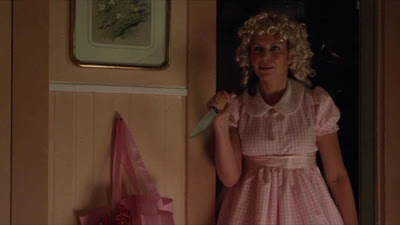
"As the predictable thriller plays out we discover through some nicely executed flashback sequences what transpired in [Henry and Catherine's] youth and how it fucked them up, but the reveal is pretty broadcast from early on, with some incestuous overtones and adolescent mind-fuckery. Content- and performance-wise this is about on par with any of the Lifetime Channel movies […], which is to say a little on the dull side, there are very few surprises and the acting is varied to be kind. While Wuhrer is always pleasing on the eyes, she and Famiglietti are a bit inconsistent in their roles […]. Bert I. Gordon's direction is solid, there's skill behind the execution with some decent low-budget cinematography, the low-budget limitations seem to be hid behind a gloss of stylized color correction; it's a nice looking low-budget digital shot movie. There's some nice atmospheric lighting, some fluid camera moves and talent behind the cinematography. The score from Scott Glashow (Hatchet III [2013 / trailer]) is sort of generic but suits the psycho-sexual melodrama nicely. [McBastard's Mausoleum]"

"It's a thrill to see Bert I. Gordon making films again, especially as he's well into his 90s […]. And Secrets of a Psychopath looks lushly terrific, a first-time digital effort from the man they call Mister B.I.G. for his larger-than-life creature features. But yikes. This thing stinks on so so many levels. [Really Awful Movies]"
Undoubtedly, were this film Italian and from the 70s, it would enjoy greater cult respectability.
Bert I. Gordon interviewed about
Secrets of a Psychopath:
Bert Ira Gordon — R.I.P.


