Save the Green Planet! — or, in Korean, Jigureul jikyeora! — is a Korean genre-bender from 2003 that was originally met with both good critiques and a number of awards (in Rotterdam, Moscow, Buenos Aires and Brussels, among other places). When the debut film of director Joon-Hwan Jang finally got an English-language release, however, it pretty much nose-dived straight into obscurity. In Europe, it went straight to DVD and has done little other than gather dust on shelves since then. A fate not at all surprising, for Save the Green Planet! is one of those rare films that defies all expectations by simply flying in the face of all of expectations. Is it a comedy? Science fiction? A horror flick? A thriller or detective movie? Some sort of social critique? It is, in the end, an original, off the wall, painful and continually surprising mix of all those genres; and as such, it is truly a movie with cojones as big as basketballs — and what it has, it knows how to use. The plot is as convoluted as it is simple, and for the sake of keeping the film’s many twists and turns and oddball and terrifying developments a surprise for the viewer, not too much of it should be revealed. In short, Lee Byeong-gu, a man whose life has been shaped by tragedy, is convinced that aliens are not only coming to destroy earth — the titular green planet to be saved — but that Kang Man-shik, the head and founder of an unscrupulous chemical corporation, is an alien spy. With the assistance of his dim and chubby circus-performer girlfriend Su-ni (Jeong-min Hwang of Black House [2007 / trailer] in a role modeled lightly after that of Gelsomina in La strada [1954 / trailer]), Lee Byeong-gu kidnaps Kang Man-shik and locks Kang up in the basement of his mountain retreat in an attempt to learn all about Kang’s "royal genetic DNA code" before the next full moon, the date of the invasion. As he and Kang play a game of physical and psychological torture, disgraced Inspector Choo (Jae-yong Lee) and the young policeman Kim (Ju-hyeon Lee) slowly hone in on the mountain hideaway... Sound simple? It is — and isn’t. The bare-bone description reveals the basic strand of the plot, but fails to do justice to the unexpected layers and crazed intricacies added to the gossamer thread. Indeed, Save the Green Planet! is one of those films that continually reveals new but relevant asides during every repeat viewing, even as it at the same time manages to reveal enough in one viewing to reach its macabre and inane but perhaps indivertibly logical ending. For a first-time director, Joon-Hwan Jang has a fine eye not only for setting up and filming scenes, but his control of his actors is top notch. Ha-kyun Shin (as Lee Byeong-gu, the possibly not-nutty nutcase) and Yun-shik Baek (as Kang Man-shik, the kidnapped businessman) excel in their roles, both doing an incredible balancing act with their characters, thus causing the viewer's sympathies to move back and forth between the two characters at any given time as the given man oscillates from being a psycho to tragic loser or from being an asshole businessman to man desperate to survive. Not that the opening kidnapping scene of Save the Green Planet! indicates that either of the two actors would do much with their parts, or that the direction would be any good, for it is perhaps the worst scene in the movie, indicating a possible eventual descent into third-rate burlesque comedy so common of so much Asian cinema (see the Japanese film Hiruko the Goblin [1991 / trailer] or the Chinese film A Terra-Cotta Warrior [1990 / trailer] for two films that are literally ruined by their Three-Stooges-like "humor"). Luckily, as much as the film retains an odd and wry humor even in its many blackest moments — and the film does indeed have a lot of truly black moments — Save the Green Planet! quickly leaves burlesque far behind in favor of a humor far less easy to describe.... Those who like their films pasteurized are probably going to find Save the Green Planet! as annoying as those who like their genre films straight up with no rocks, olives, cherries or twists. This flick is a cocktail, a cocktail with a mixture that tastes different with every sip and ends with an odd love-it or hate-it aftertaste — although it may take days before you decide which way you yourself go. But no matter whether you end up loving it or hating it, you’ll have to admit Save the Green Planet! is truly something original and different — and that alone makes it a rarity worth watching.
"Don't you see... we must follow the gypsy trail to the forbidden valley because where there is one eohippus there must be others. At least two, the sire and the mare, possibly more. Just think what you and Miss Breckenridge could do with a dozen eohippi?" Professor Bromley
(Spoiler alert.) There seems to be an unwritten rule amongst film fanatics that any production touched by the magic hands of Ray Harryhausen is sacred, almost beyond critique. Well, although the man who produced such wonderful and timeless masterpieces as The Seventh Voyage of Sinbad (1958 / trailer), Jason and the Argonauts (1963 / trailer), The Golden Voyage of Sinbad (1974 / trailer) and Sinbad and the Eye of the Tiger (1977 / trailer) really did know how to create magic with stop-motion animation, there is a reason why The Valley of Gwangi has remained one of his least-known film, and it is not just due to the supposed fact that upon its original release it was relegated to the bottom half of an adult-oriented double bill despite obviously being a kiddy film. This film has remained an obscurity primarily because it simply isn’t very good. Even when given leeway due to its intended audience, the movie still reveals itself as substandard in regards to script, direction, acting, character development and logic. Legend has it that the idea of the movie comes from an ancient, unproduced script written by Harryhausen’s mentor Willis H. O’Brien (best remembered today as the man who brought the original King Kong [1933 / trailer] to life) entitled Valley of the Mist that Harryhausen found amongst his stuff when cleaning out the garage. Fact is, however, a low-budget cowboys vs. dinosaurs flick was indeed made from the O’Brien's idea in 1956: entitled The Beast of Hollow Mountain (trailer) and shot back to back with a Spanish-language version, the film is virtually forgotten today and commonly referred to as "not as good as The Valley of Gwangi" — which means it must be pretty bad. For as appealing as the plot concept is in itself, the version that made its way to the big screen in 1969 is not. Whether due to the ancient source or the final script delivered by television scribe William Blast, the film is an unpalatable muddle. Of course, the Harryhausen sequences of animated dinosaurs are top notch and fun to watch, but the film itself is such a painful dull mess that the movie is often a painful bore. But to the film’s disadvantage, the production itself is just good enough to also prevent the film from slipping into the realm of cheesy fun, of being so bad that it is good. Okay, maybe the kiddies might like it, but if you plan to watch alongside them, then you would be better served to rent one of Harryhausen's mythical swashbucklers. In regards to Harryhausen magic, The Valley of Gwangi has too little, too late — and in between, there is nothing but predictability, right down to the racist evil stereotypes. Filmed in Spain, the story takes place at the turn of the century somewhere south of the US border. After a dark, badly filmed intro in which Carlos (Gustavo Rojo) defies the curse of the forbidden valley and disappears with an eohippus (that’s the great-great-great-great-great-great-great granddaddy of the horse, for those who don’t know), the credits roll and a third-rate Wild West show arrives in town — showing a lotta leg during the parade, considering the time frame, but that’s OK. Tuck Kirby (b-movie veteran James Franciscus, who displayed a great bod two years later in Beneath the Planet of the Apes [trailer] but died of emphysema in 1991) is also in town. An ex-stuntman of the show and one-time main squeeze of the show’s owner TJ (a talentless Gila Golan who, smartly enough, married well and retired directly after this movie), Tuck wants to buy the show’s talented performer Omar, The Wonder Horse for Buffalo Bill. At first TJ is all injured emotions, but after Tuck gets scratched when saving Lope (Curtis Arden), the movie’s mandatory child, her muff warms up again. She shows him El Diablo, her great white hope and future savior of the show — nothing less than the little eohippus, which Carlos, hot to jump on her bones, has given her as a sign of his affection. Of course, Prof. Horace Bromley (Laurence Naismith), a tippling paleontologist just happens to be in the area, and when Tuck shows him the four-legged wonder the plot finally begins to move a little. Carlos refuses to reveal where he got the tiny critter, so the two go to the unfriendly neighborhood gypsies — led by the blind gypsy Tia (Freda Jackson, best remembered as the evil servant in The Brides of Dracula [1960 / trailer]) — who are just as unhelpful. Behind Tuck’s back, Bromley instigates the gypsies to steal the wonder horse so as to follow them to the place they return it. Tuck catches them in the act and, unable to stop them, sets off in hot pursuit. Carlos lays the blame of the theft on Tuck’s shoulders — one can only assume he does so out of spite, for truly, Carlos must be able to recognize his own brethren — so soon TJ, her partner Champ (Richard Carlson of It Came From Outer Space [1953 / trailer] and The Creature from the Black Lagoon [1954 / trailer]), Carlos and two others are hot on his trail. Before long they are all in the forbidden valley, where they promptly run into three dinosaurs and find out that they, stupidly enough, have only brought the blank-shooting prop guns of their western show. (The first dinosaur that they run into is a pterodactyl which, although previously strong enough to make off with a donkey, is too weak to successfully fly off with Lope in his clutches. Carlos ends up killing the creature by twisting its neck.) All this leads up to the movie’s most famous scene of six cowboys on horses trying to lasso Gwangi, an allosaurous. Of course, the first attempt to capture the mad meat-eater fails and Carlos ends up being dinosaur food — but then he was a rat anyways, and maybe even a Mexican. When Gwangi tries to follow the survivors out of the valley, he ends up knocking himself out, so before you can ask “Hey, where did they suddenly get all that equipment?” he is being trucked back into town to take part in TJ’s wild west show. Tia does not take kindly to this, and at the creature’s premiere she has her faithful dwarf (Jose Burgos) servant release the angry allosaurous onto the audience of the full arena. (The dwarf gets eaten for his trouble, but Tia simply falls over and disappears, possibly trampled to death by the fleeing masses.) People run hither and wither, and the Professor gets flattened because, like an idiot, he runs towards the creature rather than away. Everyone who doesn’t become allosaurous lunchmeat runs into the local cathedral, the critter hot on their trial. Exiting the back entrance, Tuck plays tag with the critter before it is locked into the cathedral and barbecued. Lope cries for some strange reason and the film ends… That Lope un-understandably cries is one of the more logical aspects of the film. Why do the gypsies steal the miniature horse halfway through the flick instead of stopping Carlos in the opening scene? Why does Tia release the creature? How can the dwarf get close enough to do so? Why does the Professor run to the cage instead of away? Why don’t the pterodactyls ever fly out of the valley? How could they ever even originally start the pursuit with prop guns? Why doesn’t anyone simply lock the gates of the arena and thus stop Gwangi’s mad rampage from even beginning? Why are there no real weapons around at that time as well? Why are Mexicans in older westerns always evil? Etc, etc, etc. As mentioned before, the script is lacking. But it is the fact that everything else is also lacking that harms the film most of all…
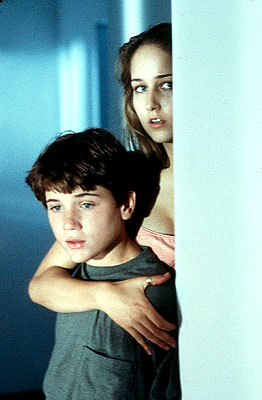
(Spoilers.) The best thing to be said about this film is that the trailer, which includes almost every decent scene in the whole movie, is pretty good. Thus, as is often in such as case, the film itself sucks. Amazingly enough, director Daniel Sackheim had over ten years of experience as a producer and director of television movies and series — including such hits as The X-Files, ER and NYPD Blue — by the time he finally got around to filming this movie, his first cinema release. But much like a not-so-youthful virgin incapable of finding the clitoris despite ten years of willy-wanking over Hustler or Penthouse, Sackheim obviously hadn't learned all that much from his past activities. Supposedly the original version of this celluloid Quaalude ran three hours in length, but even at 106 minutes The Glass House induces a deep state of REM, but without erections. Scriptwriter Wesley Strick, no stranger to ridiculously improbable scripts — as proven by those he supplied for the nonetheless entertaining Arachnophobia (1990 / trailer), the dreadfully derivative Final Analysis (1992 / trailer) and universally reviled feature version of The Saint (1997 / trailer) — but he definitely surpassed himself this time around. A shame that Martin Scorsese wasn't around to improve things, as he was for Strick's script to Cape Fear (1991 / trailer). Oddly enough, none of the actors seemingly realized that they were in the midst of making such a turkey, for they all seem to be doing their best — with the possible exception of the Leelee Sobiesky's rather one-note performance as the movie's youthful heroine Ruby Baker. But then, the names involved are hardly those of power who have a large choice of projects. In the case of Diane Lane (daughter of Playboy's October 1957 Playmate Colleen Farrington, seen here to the left), she has never been known for her ability to chose good scripts, acting ability aside. Stellan Skarsgård's involvement can be explained simply by the fact that as a character actor and foreigner — decent American accent or not — he seldom has a chance to headline Hollywood product and was probably more than overjoyed to finally get a big role with which to chew the scenery, lousy script or not. As for the various supporting actors — such as the rather unrecognizable and old Bruce Dern — in their rather minor, plot-pushing rolls, well, they too have rent to pay. Ruby Baker is the ever so typically sullen 16-year old with a chip on her shoulder and an annoying younger brother named Rhet Clark (played by Trevor Morgan, a named destined to be forgotten). Their perfect parents go out to celebrate their wedding anniversary and, instead of coming home on time, drive off the side of a road and die. At that point, one-time neighbors Terry and Dr. Erin Madre-Glass (Skarsgård and Lane) reappear as the parent-appointed guardians. Off go the kids to the Glasses' house, a huge, luxurious glass house in Malibu. But the house is less a home than a prison, the guardians less Good Samaritans than either a drug-addict or wanna-be sexual abuser. Or is Ruby simply having a hard time adjusting to everything? Well, the last concept flies out the window quickly enough, and somewhere along the way we even learn that not only was Terry responsible for the death of Ruby and Rhet's parents, but that the two-faced guardians from hell are actually after the kids' multi-million dollar inheritance. All Ruby's attempts to get help or escape come to naught and eventually she ends up lying sedated in bed, but when Erin dies from a perfectly timed overdose, Ruby and her brother make a last-ditch attempt to get away. Alas, they fail again! But then, after parking his Ferrari outside of the garage, Terry suddenly drinks himself unconscious — or does he? Ruby and Rhet break out from their cellar prison, but before they can conduct their great escape, some nasty mobsters to whom Terry owes money suddenly show up. All this leads up to a long expected and overlong scene featuring two Ferrari's — one of which has no breaks — zooming downhill… As might be expected in a turkey like this one, neither the scriptwriter nor the director obviously knows when a film should finally end. 'Cause, believe it or not, the film ain't over yet! Wake up and you get to see yet another totally pointless and over the top scene in which a battered but still kicking Terry, now looking like some indestructible zombie from a George Romero flick, tries yet again to off his youthful charges… Despite all the menace, perversity and oppressiveness found in the film, The Glass House never achieves any real tension or suspense, and its meanderingly slow pace is nothing more than monotonously boring. Even the last ten minutes of over-the-top excess does little to excite the now long-sedated viewer. Ironically enough, the spoof of some imaginary cheap and sleazy slasher film that opens the movie is far more engrossing than The Glass House itself, for Sackheim's flick is little more than a third rate B-film potboiler undeserving of the A-treatment it is given. (Hell, were the movie a lot more cheap and sleazy, it probably would have much better.) Unbelievably enough, The Glass House was given a direct to DVD "sequel" in 2006. Entitled The Glass House: The Good Mother (trailer), the film is less a traditional sequel than a third-rate remake and, as such, manages to be even worse than the original version.
Oh, God. You're gonna eat me soon, aren't you? Sydney Briar
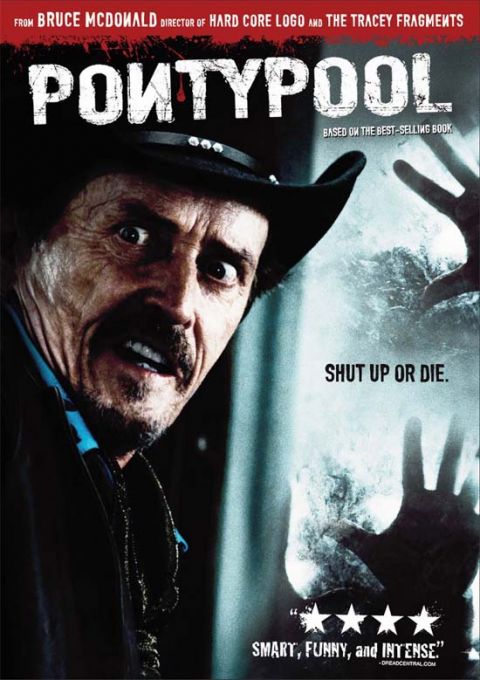
Whereas the French philosopher Georges Bataille, the author of the excellent children’s book The Story of the Eye (1928) tended to argue that communication is a contagion, it was that junky (as in addicted, not in regard to quality) US American writer William S. Burroughs who posited "Language is a virus from outer space." Over the years, as it typical of modern culture, a truncation of the quote became famous, famous enough to have an arty pop song based on it, Laurie Anderson's nifty ditty Language is a Virus. Somewhere along the line, the Canadian novelist Tony Burgess mutated the idea into a storyline and came up with the novel Pontypool Changes Everything, telling a tale in which "[a] virus had hid silently for decades up in the roofs of adjectives, its little paws growing sensitive, first to the modifications performed there; then, sensing something more concrete pulling at a distance, the virus jumped into paradigms." And then, more than a decade after his book did not make waves outside of Canada, Mr Burgess adapted his tale for a film made by the Canadian non-cult cult director Bruce McDonald, the man behind a variety of non-interesting episodes to non-interesting television shows, a few interesting cult films such as Highway 61 (1991 / trailer) or Hard Core Logo (1996 / trailer), artsy-fartsy stuff like The Tracey Fragments (2007 / trailer), and an occasional turkey of unbelievable proportions like Picture Claire (2001 / trailer). Released in 2008 under the somewhat simplified title of Pontypool, the flick did well enough that it is supposedly slated for a sequel in circa 2012, tentatively entitled Pontypool Changes.
It's not the end of the world, it's just the end of the day. Grant Mazzy
In McDonald’s semi-horror film, language is less the virus than it is infected by a virus, a virus that does not originate from outer space but from some two-bit backwoods Ontario town called Pontypool. Shock-jock Grant Mazzy (played by Meg Foster's ex-husband Stephen McHattie, an unfamiliar face of films such as Watchmen [2009 / trailer], The Covenant [2006 / trailer] and Pterodactyl Woman from Beverly Hills [1997 / trailer]), degraded by some past misdeed from big-city radio to the netherworld of backwoods broadcasting, is on his way to his morning shift at CLSY, a tiny radio station located in the basement of the local Pontypool church, when, amidst a swirling blizzard, he is greeted by the visitation of a mysterious, incomprehensibly babbling woman (Laura Nordin) that taps at his car window and then backs away into the white whirlpool of falling snow. Later, at work and on air, between his verbal faux pas, slugs of whiskey, and arguments with his producer Sydney Briar (Lisa Houle), the daily reports of lost cats and school bus cancellations give way to ever-more reports of homicidal, out-of-control and senselessly gibberishing crowds marauding through the town. But even as the BBC calls to find the truth from the uninformed center of events, no official reports are on the national news wires — other than a mysterious danger warning in French found by the radio station’s girl Friday Laurel-Ann Drummond (the pretty Georgina Reilly) that ends with the advice of not translating the statement. Dr. Mendez (Hrant Alianak) climbs through the window seeking safety soon after, revealing that the delusional madness of the crowd is the result of a virus conveyed by the English language and that one must more or less shut up or die. The three are forced to take refuge in the soundproof radio booth after Laurel-Ann becomes infected and the church is attacked by a deranged crowd — is there any hope of survival?
We're not talking, I'm drunk. This is how my last relationship ended. Sydney Briar
Pontypool has all the trappings of a low budget horror film — small cast, few locations — but despite one death scene of explosive and bloody expectoration, the film is less a true blue, blood and guts muncher or horror film than it is a diverting and mildly interesting "Kammerspiel" which, dressed in gossamer neo-zombie accouterments, plays with language and the human social interactions. Sydney's incidental statements regarding the town's inhabitants and secrets are often more interesting than the events of supposed horror, but for that, the film still manages to effectively reflect the increasing dread and fear that arises when caught within a mysterious situation in which everything outside is falling apart for no visibly apparent reason. The film conveys the feeling that all those involved were less interested in making an effective horror film than they were in simply making something different. In that, they succeeded — but don’t expect to be scared by it.


 Save the Green Planet! — or, in Korean, Jigureul jikyeora! — is a Korean genre-bender from 2003 that was originally met with both good critiques and a number of awards (in Rotterdam, Moscow, Buenos Aires and Brussels, among other places). When the debut film of director Joon-Hwan Jang finally got an English-language release, however, it pretty much nose-dived straight into obscurity. In Europe, it went straight to DVD and has done little other than gather dust on shelves since then. A fate not at all surprising, for Save the Green Planet! is one of those rare films that defies all expectations by simply flying in the face of all of expectations. Is it a comedy? Science fiction? A horror flick? A thriller or detective movie? Some sort of social critique? It is, in the end, an original, off the wall, painful and continually surprising mix of all those genres; and as such, it is truly a movie with cojones as big as basketballs — and what it has, it knows how to use.
 The plot is as convoluted as it is simple, and for the sake of keeping the film’s many twists and turns and oddball and terrifying developments a surprise for the viewer, not too much of it should be revealed. In short, Lee Byeong-gu, a man whose life has been shaped by tragedy, is convinced that aliens are not only coming to destroy earth — the titular green planet to be saved — but that Kang Man-shik, the head and founder of an unscrupulous chemical corporation, is an alien spy. With the assistance of his dim and chubby circus-performer girlfriend Su-ni (Jeong-min Hwang of Black House [2007 / trailer] in a role modeled lightly after that of Gelsomina in La strada [1954 / trailer]), Lee Byeong-gu kidnaps Kang Man-shik and locks Kang up in the basement of his mountain retreat in an attempt to learn all about Kang’s "royal genetic DNA code" before the next full moon, the date of the invasion. As he and Kang play a game of physical and psychological torture, disgraced Inspector Choo (Jae-yong Lee) and the young policeman Kim (Ju-hyeon Lee) slowly hone in on the mountain hideaway...
 Sound simple? It is — and isn’t. The bare-bone description reveals the basic strand of the plot, but fails to do justice to the unexpected layers and crazed intricacies added to the gossamer thread. Indeed, Save the Green Planet! is one of those films that continually reveals new but relevant asides during every repeat viewing, even as it at the same time manages to reveal enough in one viewing to reach its macabre and inane but perhaps indivertibly logical ending.
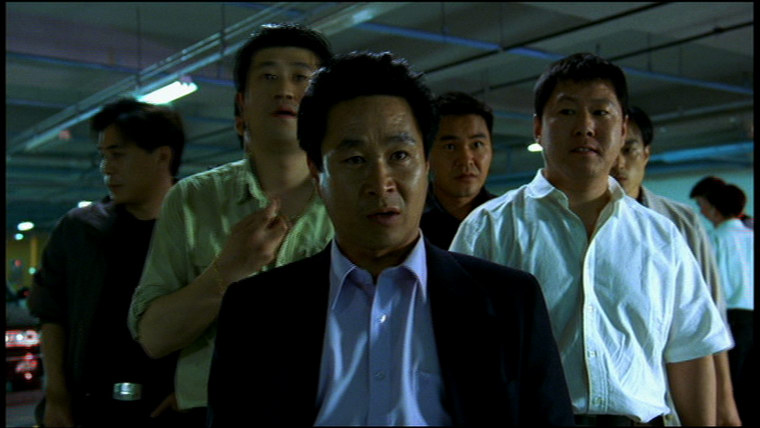 For a first-time director, Joon-Hwan Jang has a fine eye not only for setting up and filming scenes, but his control of his actors is top notch. Ha-kyun Shin (as Lee Byeong-gu, the possibly not-nutty nutcase) and Yun-shik Baek (as Kang Man-shik, the kidnapped businessman) excel in their roles, both doing an incredible balancing act with their characters, thus causing the viewer's sympathies to move back and forth between the two characters at any given time as the given man oscillates from being a psycho to tragic loser or from being an asshole businessman to man desperate to survive.
 Not that the opening kidnapping scene of Save the Green Planet! indicates that either of the two actors would do much with their parts, or that the direction would be any good, for it is perhaps the worst scene in the movie, indicating a possible eventual descent into third-rate burlesque comedy so common of so much Asian cinema (see the Japanese film Hiruko the Goblin [1991 / trailer] or the Chinese film A Terra-Cotta Warrior [1990 / trailer] for two films that are literally ruined by their Three-Stooges-like "humor"). Luckily, as much as the film retains an odd and wry humor even in its many blackest moments — and the film does indeed have a lot of truly black moments — Save the Green Planet! quickly leaves burlesque far behind in favor of a humor far less easy to describe....
 Those who like their films pasteurized are probably going to find Save the Green Planet! as annoying as those who like their genre films straight up with no rocks, olives, cherries or twists. This flick is a cocktail, a cocktail with a mixture that tastes different with every sip and ends with an odd love-it or hate-it aftertaste — although it may take days before you decide which way you yourself go. But no matter whether you end up loving it or hating it, you’ll have to admit Save the Green Planet! is truly something original and different — and that alone makes it a rarity worth watching.